Animals Rewrote the Script on Neurodivergence in Irish Theatre
Words: Izzy Copestake
If you haven’t had the chance to see Animals in the Abbey yet, then we’ve got some bad news for you. The play, based on the critically acclaimed short stories of award-winning Irish writer Blindboyboatclub and adapted by theatre and filmmaker Dan Colley, is coming to a close this Saturday with all of its final performances utterly sold out.
And it’s obvious to see why. The play is just as chaotically hilarious as it is deeply moving, with each of the actors bringing an incredible energy and sensitivity to a story that tackles childhood, identity, trauma and crucially, the experience of growing up neurodivergent in a world that wasn’t built for you.
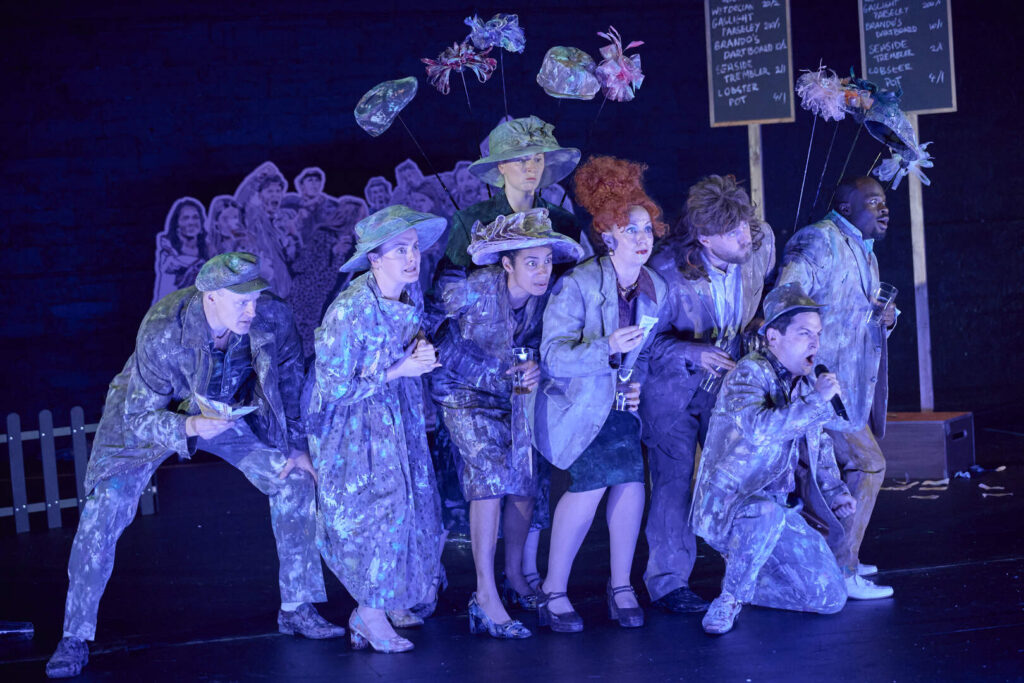
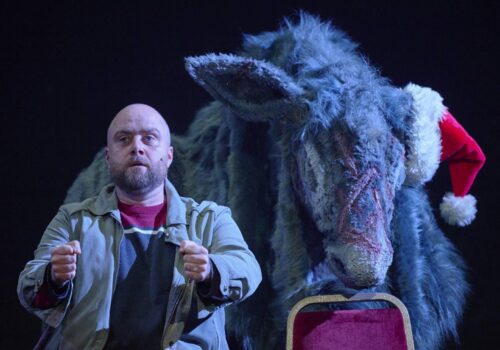
Aspects of neurodivergence are woven throughout the characters and stories we see on stage. The play opens by introducing the concept of ‘umwelt’ – the idea that every living creature experiences the world differently through its own unique sensory system. It reframes neurodivergence as a difference in perception rather than an issue to be solved or a disorder. We see this through Erskine Fogarty, for whom the weight of navigating a neurotypical world is personified by an enormous fridge-freezer he carries on his back. It’s also explored through the Irish folklore surrounding fairies and changelings in the Potín Maker adaptation, which references how neurodivergent children were historically misunderstood and sometimes cast out as changelings because of their differences from their peers.
What Colley and the team are able to achieve with a relatively simple set is astonishing. The play follows a series of short stories, requiring multiple different sets in quick succession. Through live camera work, puppetry, masks and clever visual effects, Colley and his team manage to bring these overlapping and interlinking stories to life without relying on elaborate high-budget sets.
“I knew that he [Dan] was using a camera live on stage, that he was using puppets… and that’s what drew me towards him,” Blindboy told us. “The process of handing your writing over to someone like Dan, It’s like my collection of short stories is an album, and now I’m handing it over to a fucking house DJ or a jungle DJ to remix this album, and that’s what Dan did, but Dan’s process is highly collaborative.
“It’s like my collection of short stories is an album, and now I’m handing it over to a fucking house DJ or a jungle DJ to remix this album.”
“Things happen in the moment as part of a process and collaboration, and feeling and trying and playing, playfulness. During rehearsals, seeing the way that Dan works with the team. It’s children at play, but highly skilled and experienced children.”
Yet amongst the chaos, hysterical laughter, and absurdity sits something tender. For many audience members who might relate to Blindboy’s own experience of growing up neurodivergent, this theatre works to make them feel seen, in more ways than one.
We spoke to Blindboy about Animals, specifically, the scenes which have catapulted so many audience members back into their own childhoods, and feeling misunderstood by a neurotypical world. “Details are changed to assist the mechanics of fiction and storytelling, but most of it is based on my actual childhood, my childhood as an autistic kid who didn’t know he was autistic,” Blindboy told District. “It centres around a very real thing that happened to me when I was 4 or 5 years of age.”
“Most of it is based on my actual childhood, my childhood as an autistic kid who didn’t know he was autistic,”
The most emotionally charged section of the play centres on a very young, autistic child based on Blindboy’s own experience, whose fascination with the solar system and dinosaurs sets him apart from his peers. This child is taken into the older children’s classes to speak about the facts he knows about the solar system, until he realises he is being used as a tool of shame to make the older children feel bad about their lack of knowledge.
“I didn’t like that, it felt manipulative, but I used to prefer talking to adults when I was about 5. I preferred talking to adults because an adult might want to talk about dinosaurs or the solar system, whereas children my age didn’t,” Blindboy said, “Again, that’s very common with autistic people, with autistic kids, that’s quite common.”
The story then moves to a playground, where the young child approaches a woman and her daughter to share a fact about the future of the solar system: that one day, the sun will expand and the world will end.
“This woman, who must have been in her 40s, she got really upset by this and she beat the living fuck out of me. She beat me the way you’d beat an adult, you know, she really, really beat me. There was blood coming down my face. I was 5. It was so traumatic, I’d forgotten it until adulthood.”
“It was so traumatic, I’d forgotten it until adulthood.”
Blindboy explained the process of revisiting this traumatic experience through his writing. “Part of my writing process is that I try to bring an element of journaling into my writing. What I mean by that is being as emotionally raw and vulnerable as possible on the page, and trying to revisit early childhood memories to enter a meditative flow state where I feel safe enough now.”
“It’s about holding the hand of the little child within me, holding that terrified, frightened, confused child’s hand and saying, “I’m here now. I’m an adult now. You have a voice now. You can stand up for yourself. You can call things out when you see them. Nobody’s going to beat you now.” And to engage in that internal process of adult me providing safety for child me, and walking back to that playground where that abuse happened.”
“It’s about holding the hand of the little child within me, holding that terrified, frightened, confused child’s hand and saying, “I’m here now. I’m an adult now. You have a voice now.”
Indeed, all aspects of the production felt as though it was holding on to the experience of that younger, autistic child and making accommodations for their needs. One of the ways the team did this is through accommodations for neurodivergent audience members. “There’s fidget spinners for people who need to stim, there’s noise cancelling headphones,” Blindboy told us. “Most importantly, when you come to the play, you can kind of come and go as you please, there’s no pressure to stay sitting in your seat.”
“There’s fidget spinners for people who need to stim, there’s noise cancelling headphones,”
Blindboy told us that this accommodation relates to his own experience with social anxiety when he was younger. The crippling nature of the anxiety prevented him from going to the theatre, as he was worried about being trapped in the room, and the potential of having a panic attack.
“So what happens then? I just don’t go to the theatre. I just do not go to the theatre. I’m a 19-year-old kid who has the imagination and ability to write, and the creative turn to eventually get to the Abbey Theatre, but effectively a lot of my opportunities for learning and education and experiencing theatre are cut short at a very early age because the theatre is a space that’s quite threatening to me as an autistic person.”
“And I think about that an awful lot. When I’m thinking about neurodivergent people who are creative, in particular young neurodivergent people, what art galleries are they not going to? What gigs are they not going to? What spaces are they not participating in that other people can participate in? What are they missing out on because of their neurodivergence?”
“What are they missing out on because of their neurodivergence?”
The very existence of Animals has made Irish theatre more inclusive. There’s so much to take from its mad web of rich characters, absurdity and true vulnerability, but you can’t separate what makes this play so good and engaging from what makes it inclusive. The same thing that makes this performance a whirlwind of creativity is also what makes it such a welcoming space for neurodivergent audiences. In the words of Blindboy, “Neurodivergent people have always existed. The problem is society.”