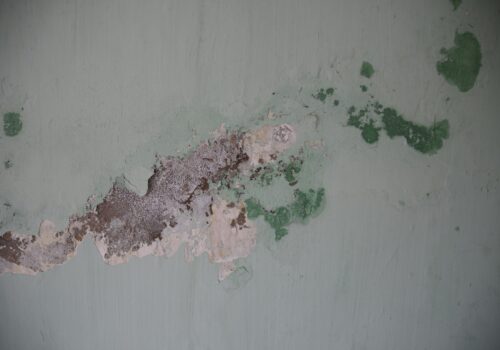
Galway Has A Mould Problem and Students Are Suffering
Text: Tara McGivern
In the last year, rent increases in Galway have been the most dramatic in the country, with an 18% rise recorded year on year. This rent crisis has left many renters scrambling to find accommodation, and the limited options available are often far from ideal.
Students in particular are affected. Most students are unable to work full time alongside their studies, leaving many strapped for cash. A lack of official student accommodation adds to the problem. Take the University of Galway, for example. It has fewer than 2,000 beds for more than 20,000 students. As a result, many students resort to dodgy sublets and subpar accommodation within their price range. Speak to any student in Galway struggling to find a place and you’ll receive the same answer when you ask what the main problem is, aside from the astronomical cost: mould.
Mould is an issue in Galway generally. In 2024, Mairéad Farrell, Sinn Féin TD for Galway West, conducted a survey which showed 90% of respondents had maintenance issues in their homes, in large part thanks to mould and damp. Just last year, Galway County Council logged 124 mould complaints from constituents in two of the county’s housing schemes (HAP and RAS).
The specific data around mould in student rentals is less up to date. However, in 2021, the University of Galway Students’ Union conducted research which showed that over 50% of students’ housing had mould and damp. Ask any student renting in Galway today, and they’ll be familiar with the horror stories.
Over 50% of students’ housing had mould and damp in their homes.
On my own first day in the county, a tourist vacating an Airbnb I was viewing as student accommodation for the academic year pulled me aside and whispered, ‘There’s mould in the wardrobes.’ My stomach dropped, but after viewing more properties and speaking to other students, I realised mould in my wardrobe was minor compared with what other people were dealing with.
One university student I spoke to found mould growing on her pillow. Dúnaras is university-approved student accommodation on the edge of the city. Anna, 23, who moved into Dúnaras in September 2025, showed me where mould had sprouted in her apartment.
‘The village [I live in] is university approved. It’s a private one,’ Anna told District. ‘There was mould in my pillow. I was changing the sheet and saw dots […] We have dehumidifier boxes […] and then I have my fan on in my bathroom all day. Which is unfortunate because it uses a lot of electricity.’
‘’The village [I live in] is university approved… There was mould in my pillow.’
What’s the cost of having a room plagued with mould? ‘Rent is €840 a month and electricity depends. This month it was €50 [each]; we had [the dehumidifier] on quite a lot because the house was quite damp.’
The unseen costs of a mouldy house? Your health, ‘My roommate was always coughing. When we cleaned the mould from her window it would stop.’
‘My roommate was always coughing. When we cleaned the mould from her window it would stop.’
Anna’s story is not unique. Masters student Hannah, 23, lived in Sceilg Ard, a popular estate for student accommodation further away from the city. ‘I knew the girl who was living in my room the year before. She sent me pictures of the mould in the room. She sent me photos from the sitting room too. The shower had broken and was leaking down into the sitting room. There was mould everywhere. I couldn’t find anywhere else; it was €450 a month.’
‘The shower had broken and was leaking down into the sitting room. There was mould everywhere. I couldn’t find anywhere else.’
Katie, 22, spent time in Galway for Erasmus late last year. She found her accommodation on StudentPad, a website created by the University which lists advertisements for student accommodation. She paid €255 a week for her room.
‘It was advertised as a B&B on StudentPad. I lived with five other girls, all exchange students as well.’ Katie said. ‘It [mould] was growing on the ceiling and on the furniture provided.’
‘It [mould] was growing on the ceiling and on the furniture provided.’
‘We complained to the landlord, and he told us he’d come by the room to “treat it”. When he came, he just wiped it away with a sponge soaked in soap and water. He just left it like that. Inevitably, it came back a few weeks later.’
Katie was also sick whilst living in her accommodation. ‘After a month or so, we all started getting sick all the time. I was sick constantly from September to December, until I left.’
‘After a month or so, we all started getting sick all the time’
Dr Victoria Veich is a GP in Clonmel, County Tipperary. She told District that mould-related illnesses are common and especially dangerous to those with pre-existing conditions like asthma, ‘Indoor air, especially that with mould spores in it can be dangerous. It can trigger chronic asthma and make an asthma attack more severe.’
‘Indoor air, especially that with mould spores in it can be dangerous. It can trigger chronic asthma and make an asthma attack more severe.’ – Dr Victoria Veich
The Health and Safety Authority says that certain types of mould can cause infections in those with suppressed immune systems, while other strains known as toxigenic mould can cause cancer.
Veich stresses that everyone deserves a safe home, ‘If your rented house does have mould, your GP can help to write an advocacy letter to your landlord or local authority discussing how mould impacts your health or the health of your family.’
‘If your rented house does have mould, your GP can help to write an advocacy letter to your landlord or local authority discussing how mould impacts your health or the health of your family.’ – Dr Victoria Veich
Mayor of Galway and Labour Councillor Helen Ogbu first mentioned mould to her fellow councillors in November of 2025. She cited Awaab’s Law in the UK as a signal that change is needed here in Ireland. Awaab Ishak was just two years old when he died in 2020 after being exposed to mould in the social housing he shared with his parents.
Worryingly, Ogbu has received complaints from constituents concerned about their own health. She told District, ‘There are those who have children, and their children, are continuing to have or maybe just kind of showing signs of related ailments.’
Ogbu noted that a number of students have reached out to her, ‘Sometimes you find out most of these houses are actually rented out to students…because they just feel students don’t have a voice. People are afraid to complain, because they don’t want to be homeless.’
‘Sometimes you find out most of these houses are actually rented out to students…because they just feel students don’t have a voice.’ – Mayor of Galway and Labour Councillor Helen Ogbu
She believes part of the problem is that students don’t always know who to complain to, ‘Most of the time they are actually sublets to students. So, who do they complain to?’
The stories in this piece are not unusual. Students describe mould as something to be expected, fearing that speaking up could leave them without a place to live. Until there is enough safe, affordable accommodation in Galway, many will continue to weigh the risks of living in damp, unhealthy homes against the certainty of having nowhere to go.
*For this article, we have left all students anonymous as they fear the impact recognition would have on their future ability to secure accommodation in Galway.
In response to the issues raised in this article, a spokesperson for the University of Galway said: “Our Accommodation Advisory Service provides students with general information and resources such as our “Know Your Rights” webpage, which also directs students to relevant guidance and advice on Citizens Information.
“Students experiencing difficulties with their accommodation are encouraged to contact organisations such as the RTB and Threshold, which are best placed to provide the expert advice, advocacy and support in relation to tenants’ rights and dispute resolution.
“In general, the standards in private rental accommodation is something that our Accommodation Advisory Service is aware of and related issues have been raised with us by students us over the years. The climate in the west of Ireland and the type and age of housing stock available to them, particularly in Galway city, mean that issues related to damp and mould are often more complex than it first appears and the causes can vary from property to property, including ventilation, heating, BER ratings, quality and condition of windows and doors and general maintenance.
“There is value in ensuring that both landlords and tenants have access to clear, practical information on preventing and addressing issues, so we would advise a balance between awareness, education and that early intervention is an initial and constructive starting point. We would also support wider efforts to educate landlords and students on good practice and the supports available to them.”
*For this article, student’s names have been changed due to a fear it would have an imact on their future ability to secure accommodation in Galway.