In Sligo, Surfing Is Combating Rural Loneliness
Words: Philip Theiss
Lead Image: Britton Archive
As rural Ireland grows lonelier, surf communities along the west coast are creating new places to belong.
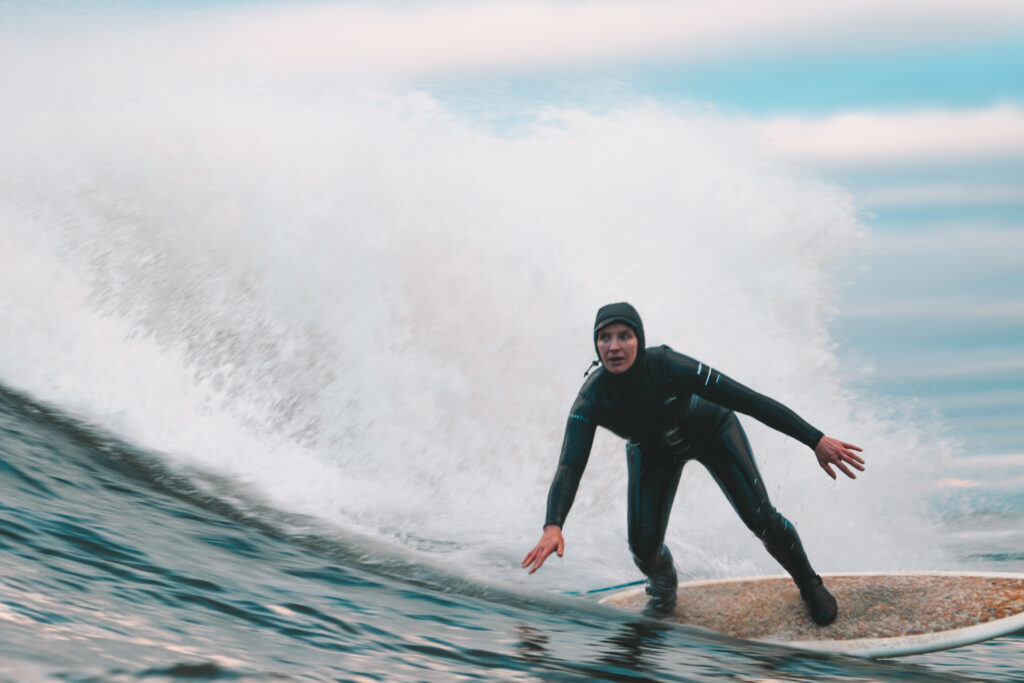
A cold wind pushed across Strandhill beach on a seemingly unremarkable grey Monday afternoon in March. Out beyond the break, surfers floated in dark clusters, scanning the horizon as more pulled on wetsuits beside vans in the carpark, carrying boards under their arms, and jogging into the water. Along the boardwalk, groups of people stood watching with cameras tucked beneath rain ponchos. The surf shop next door had a line out of the front, the cafe beside it had no empty tables.
Nothing about the day felt remarkable otherwise. Schools were on, offices were open, and summer was still far away. Yet the beach was full of people and a sense of community.
In much of Sligo and neighbouring counties, scenes like this have become increasingly rare. For decades now, the government has been stripping vital services from rural Ireland. The state shuttered Garda stations, abandoned banks and post offices, slashed bus, rail and regional air services, and weakened municipal authority. Secondary effects followed. Pubs closed — nearly 2,200 nationwide since 2005. School enrolment shrank. GAA clubs struggled to field teams. Young people left for Dublin, London, or Australia. What remained was a slow emptying out of places to be, and people to meet there — fewer familiar run-ins, fewer reasons to leave the house. Ultimately: a loss of community, of connection, and as such, more loneliness.
A 2023 study by the European Commission, revealed Ireland to be the loneliest country in Europe. Twenty percent of people in Ireland stated that they feel lonely most or all of the time. Remove the cities from that equation, and rural towns average higher.
Twenty percent of people in Ireland stated that they feel lonely most or all of the time.
Strandhill is technically one of these. Towns by the beach however, have something the others do not: waves.
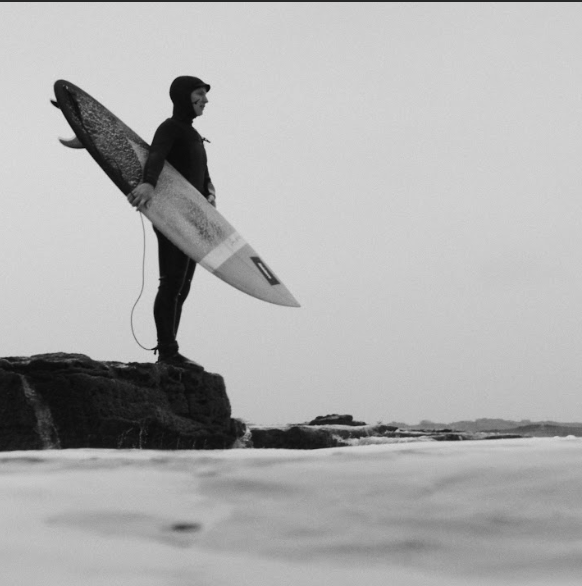
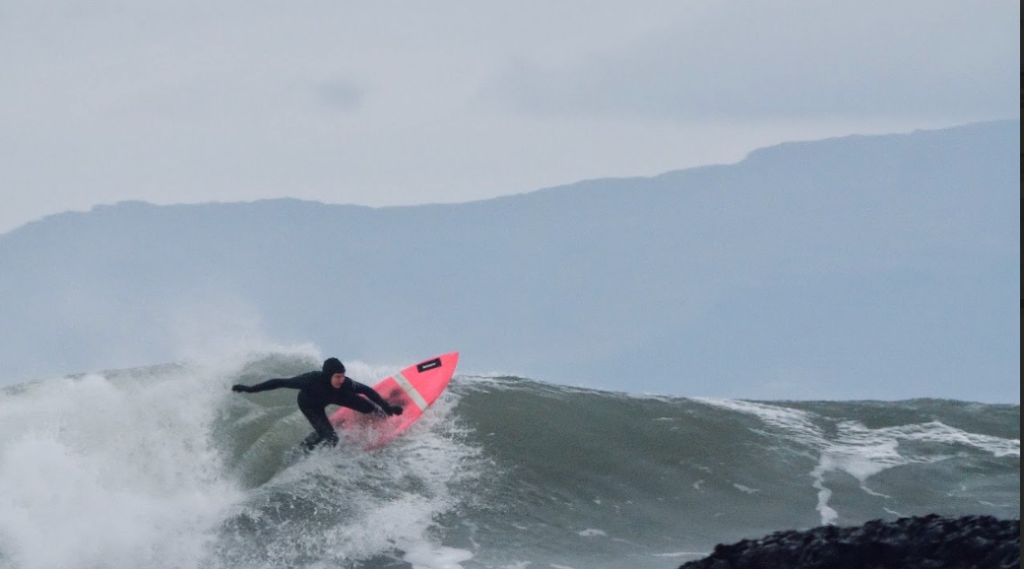
Easkey Britton was born in Rossnowlagh Co. Donegal in the 80’s, and was standing on a board by age four. Back then, a full lineup might have meant two people bobbing at the break and a car park with some room to spare. In her school, she was the only surfer. “I’d surf in wintertime, come back after school just before dark, and maybe get half an hour of light. No one else was on the beach”, she recalls. Today, Easkey is undeniably an Irish surfing legend: a five-time Irish champion, a big wave surfer, an author, and a marine social scientist. Simultaneously, she lived through the Irish surf scene’s shift from a solitary, inherited craft, to what it is today. She pointed out, simply: “Wetsuits got a lot better. Surf forecasting improved. That was all around the late 90s onwards.”
“I’d surf in wintertime, come back after school just before dark, and maybe get half an hour of light. No one else was on the beach”,
Suddenly, you could check a forecast on a Thursday and know there would be waves on Saturday, drive across the country with confidence, and stumble upon a lineup of new faces. The internet put Irish waves on the world map. By 2008, a documentary called “Waveriders” came out, narrated by Cillian Murphy and featuring Kelly Slater alongside a young Easkey Britton. The film showed audiences what was possible. Quickly, surf schools and surf shops began appearing along the coast. International big-wave pros who might have previously dismissed Ireland as too cold, began showing face on the cliffs of Mullaghmore on frigid January mornings. In surf towns along the west coast, the lineups grew increasingly busier. But for locals, did any of this actually help?
The explosion of Irish surfing itself wasn’t a community, but maybe it’s what made the idea of a community possible again. Easkey credits the surf clubs. “They’re intergenerational, voluntary, membership-based, not commercial, you can’t underestimate the role of the surf clubs. They’re transformational.”
“You can’t underestimate the role of the surf clubs. They’re transformational.”
Easkey excitedly talks of cafes like Foam and Buoys & Gulls — surfer-run, that bookend life for the locals. “That’s where you’re waiting for the tide or the wind to change,” she says. “Informal meeting spots. Passing tidbits of information. A way of checking in on each other.”
Liam Ahern grew up surfing on the West Cork coast, equally in the before-times Easkey knew as well. At the time, the only swell chart was the horizon. Getting to the beach meant cycling down and hoping. “I used to ring a woman who didn’t know anything about surfing,” he says. “I would just say, ‘Is there anybody in the water?’ And she’d say, ‘Yeah.’ And I’d go, ‘Okay, I’ll go down.’”
Liam has been teaching surfing at Inchydoney Surf School in the namesake town for over 20 years. At the surf school, he explains, kids stay after their session, rinsing their wetsuits alongside the older surfers. While the young surfers learn to read the waves while sitting in the lineup, they also learn to read each other. “It’s not even the surfing,” Liam says. “They get really amazing people skills.” Liam points to two surfers he’s watched grow up at the school: one 17, the other 22. “They’re teaching now”. After lessons, they don’t go home. They hang out with the older crew. “It doesn’t matter who you are,” Liam says. “As long as you’re as interested [in surfing] as the other person, that’s equal.” Liam tells the story of two 11-year-old girls who met at surf camp. They became pen pals — with actual letters, with which they planned when they would come back to Inchydoney. Their parents organised the whole family holiday around when the girls could do surf camp together. “It’s not cheap to go on holidays,” Liam says. “But they did it.”
When Liam isn’t teaching at the surf school, he works as a special needs assistant in schools. For him, the two jobs inform each other. He’s passionate about bringing people into surfing who might never have considered it. Liam remembers one special needs student who came in for lessons. “The first day, the kid was so nervous, a few lessons later, he was taking off on waves himself. Riding left and right. You look at him and go, ‘This is way better than most people do.’ And you’re not lying.” The parents couldn’t believe it. “‘We didn’t even know this was possible’, they’d say”. What they usually hear is what their son can’t do. But, “then they’re out in the water with a surf instructor and standing up on the board.” Liam sees it in everyone who sticks with surfing. “The majority of the best surfers I know,” he says, “aren’t your classic great sports people.” They simply found something in the ocean that wasn’t waiting for them on land. “The local beach here, for most surfers, it’s their therapy,” Liam says. “Even just coming to the beach, that could be someone’s only social interaction for the two days a week the waves are good.”
“The local beach here, for most surfers, it’s their therapy,”
Easkey agrees. It doesn’t matter who you are or what the world has decided you can’t do. In the water, those labels fall away. “The ocean is such an equalizer,” she says. “You’re shedding your land-based persona. You can’t control it, you have to surrender. Surfing is inherently playful. It creates joy that’s childlike again. There’s no real purpose other than it makes you feel good.” And yet, the play really does have a purpose. Surfing, she says, has a huge potential to combat loneliness, because it connects people deeply to nature and, through that, to one another.
“You’re shedding your land-based persona. You can’t control it, you have to surrender.”
Surfing doesn’t always welcome strangers. The cost of a board and wetsuit alone puts it out of reach for many, and in certain places, localism can make a newcomer feel unwelcome. But surf schools and clubs help. And charities do vital work to make the sport more accessible. There just aren’t many of them, and the spaces they have are just as few. Though through one such charity, Liquid Therapy, Easkey has seen it work for people who need it most: asylum seekers who arrived in Ireland, in direct provision centres with no integration, no community. When surfing does reach someone, she says, “it creates place connection and a shared natural high.” Before you know it, you’re in the water with everyone else. “You meet the local GP, the builder, the person who works in the café, the teacher, a whole mix of everyone who actually lives and works here. You can lean on each other for help in different aspects of life, because yes, you surf, but you actually do all this other stuff.”
Obviously, a lineup full of surfers is not the same as a country full of company. Even drive twenty minutes east from Strandhill, and the empty pubs and streets are likely commonplace. The government seemingly doesn’t see rural loneliness as something worth directly addressing, and there still isn’t a bus to Inchydoney. But as the waves roll in as they always have, something new is happening in the water. Something alongside the crowds, not maybe always visible to the casual observer from the car park, but definite. Surf clubs where everyone paddles out together. A Saturday morning women’s group with an active WhatsApp chat. A local teaching kids to surf as Gaeilge.
That Monday in Strandhill, watching the surfers come back in, discussing the day’s events, maybe the bustle really was something more. Maybe it’s belonging, finally. Whether a full lineup can ever be the same as a full pub, a busy schoolyard: a town where people stay, is a question only the people who live there can answer. The waves, at least, aren’t going anywhere. And maybe for the first time in a while, neither are they.