On The Ground At The Belfast Riots
Words: Seán Óg Ó Murchú
Images: Cover image via X, other images via Seán Óg Ó Murchú
What follows is a first-hand report and images from Belfast-based Irish writer and journalist Seán Óg Ó Murchú, who was on the ground as violence unfolded across the city yesterday. Moving through the affected areas as the night got later, Seán documents the rapid descent into violence, scenes of arson and intimidation, and the impact on the migrant communities which this violence explicitly targeted.
On Monday night, a horrific knife attack in North Belfast was filmed and widely shared online. The victim suffered significant injuries to his eyes and face. While videos of a graphic nature are nothing new, and many people have become desensitised to this sort of content, this footage was, unfortunately, particularly horrifying. This, on top of the fact that the alleged perpetrator, now in police custody, is a Sudanese man in his thirties, created palpable tensions among an increasingly dangerous section of Irish society that heightened as the hours passed on Tuesday afternoon.
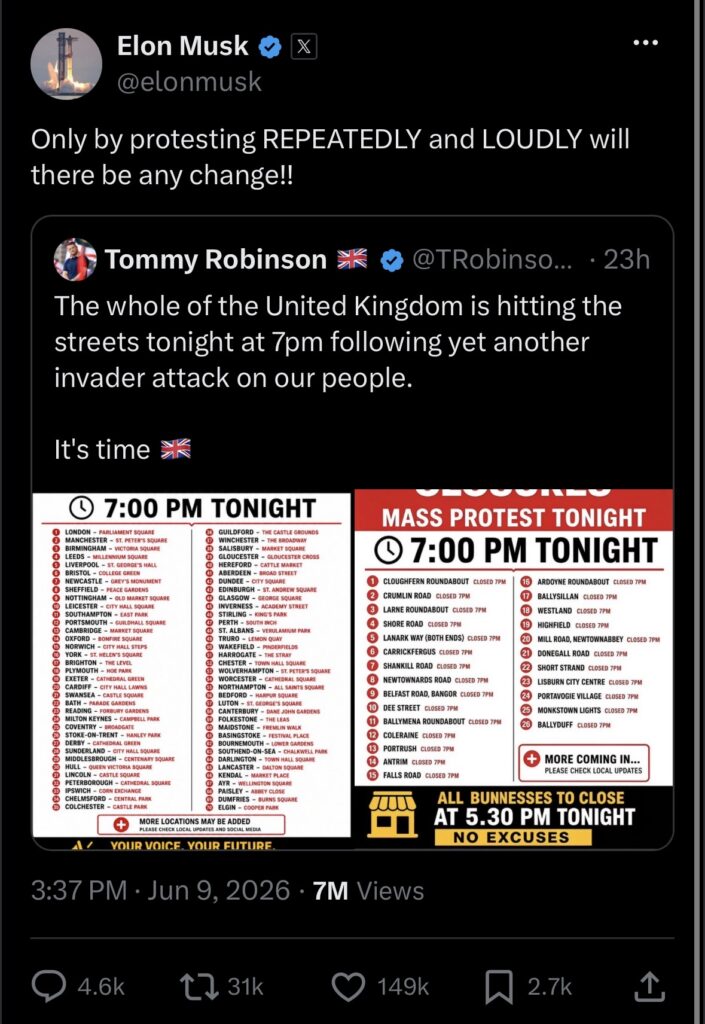
It wasn’t long before AI-generated infographics appeared online calling for mass protests throughout the six counties, and the closure of roads and “bunnesses” (businesses). It wasn’t long either, before these posts were amplified by prominent Far-Right figures such as Tommy Robinson and Elon Musk. While the calls to action were made for both Republican and Loyalist-dominated communities, and it can’t be denied that anti-immigrant and Far-Right sentiments are shared across both sides of the green and orange divide, it would predominantly be the latter that adhered.
I got off the train at Belfast Grand Central at seven in the evening. At Shaftsbury Square, it was evident that businesses had done what they were told. Most shutters, particularly those attached to establishments owned by foreign nationals, were down. Even the famous Lavery’s pub had shut its doors. Later, on the Donegall Road, a man slowed in a car and asked a PSNI officer if there was a shop open anywhere. The policeman, seeming almost humoured by the question, told him they were all shut.
Footage shows cars being brought to a halt, and the nationalities of the drivers and passengers checked, before the crowd closed the road.
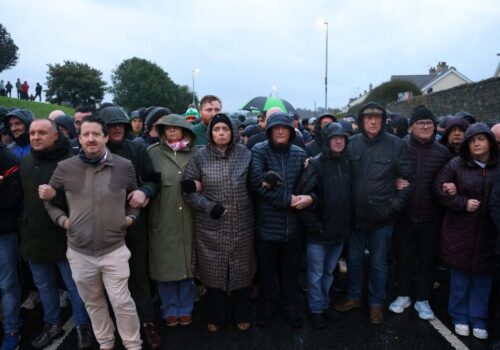
I made my way to the Broadway Roundabout, known locally as the Balls of the Falls, where a small crowd had gathered and set up a checkpoint. Footage shows cars being brought to a halt, and the nationalities of the drivers and passengers checked, before the crowd closed the road. Young men, clad in black, could be seen standing with bricks and concrete. PSNI presence at the time was minimal, with one car parked at the bottom of Tate’s Avenue, well out of sight of where the checkpoint and road closure had been established.
Young men, clad in black, could be seen standing with bricks and concrete.
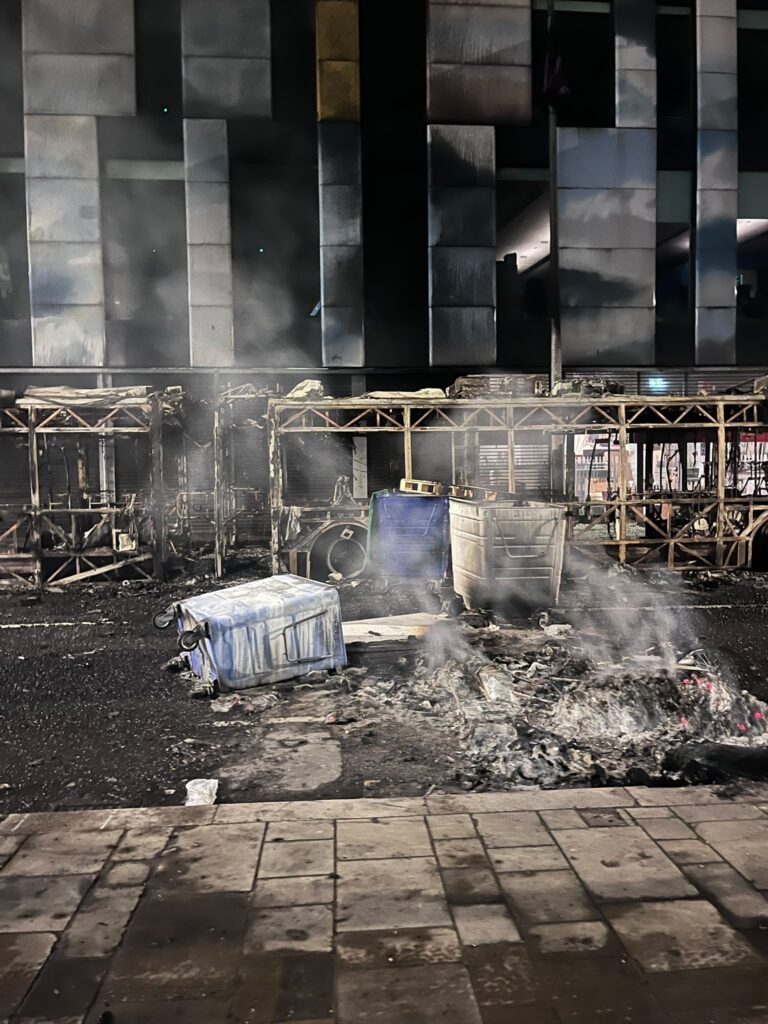
At around eight o’clock, a contact on the ground in East Belfast informed me of a Glider bus hijacked and about to be set alight on the Newtownards Road, so I made my way there. On Templemore Avenue, the shutters of Bread & Banjo, an artisan bakery, had been vandalised with spray paint reading, “Fuck Islam”.
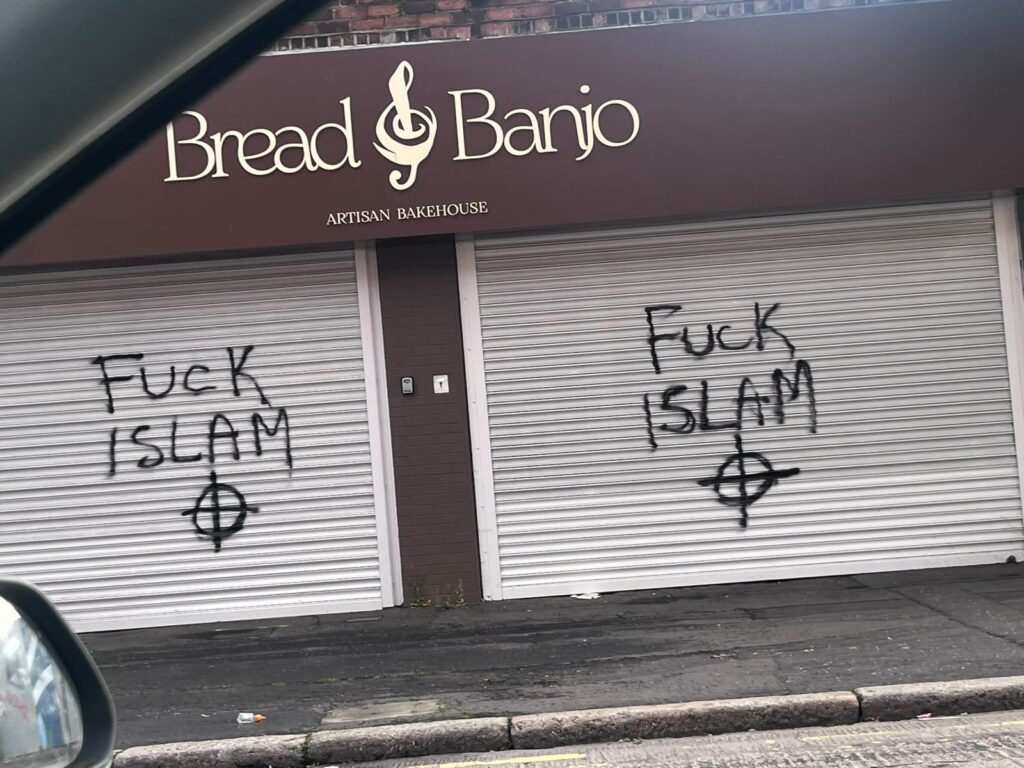
A contact on the ground in East Belfast informed me of a Glider bus hijacked and about to be set alight on the Newtownards Road, so I made my way there.
Shortly after nine o’clock, just off the Newtownards Road, on McMaster Street, a car had been set alight as crowds chanted, “East, East, East Belfast,” and PSNI Land Rovers reversed on the other end of the street and drove away. It was then I heard shouts telling me to put my phone away, so I made my way to Lendrick Street, the next street over, where another car was tipped over on its side, and the one parked behind it was smashed up with a metal pole. At this point, I was approached by a man from Manchester who mistook me for a supporter. A supporter himself, he told me that he felt inspired by what he was seeing, and he longed for violence of a similar scale in his own country. “This makes me ashamed to be English,” he told me.
A great amount of commotion spread through the crowd then as a man who was engaging in the violence was isolated, and rioters screamed at him to remove his mask, accusing him of being a “foreigner.” He was then de-masked and, fortunately, escorted away from the trouble, being warned to stay away from the area. I spoke to him afterwards, but he had a clear smell of alcohol on his breath. He was Polish and luckily walked away unharmed. At nearly ten o’clock, four PSNI Land Rovers raced up the Newtownards Road and were met with a crowd throwing missiles. The police seemed reluctant to engage.
A man who was engaging in the violence was isolated, and rioters screamed at him to remove his mask, accusing him of being a ‘foreigner.’
By half past ten, I had made my way to the bottom of the Lisburn Road, where Sandy Row had been cordoned off. A migrant-owned shop, which was made a target of Far-Right violence in 2025, had been attacked once again with a firebomb of some sort. By the time I arrived, residents of the block of flats above the shop were standing along the Lisburn Road in the lashing rain, while more residents were evacuated. At one stage, a young baby could be seen being taken into a police car. It can be noted that the vast majority of these people were foreign nationals.
A migrant-owned shop, which was made a target of Far-Right violence in 2025, had been attacked once again with a firebomb of some sort.
By eleven o’clock, a quick drive west showed quiet scenes around the Balls of the Falls and the Springfield Road, aside from sporadic, dying fires along the way. At midnight, I was back on the Newtownards Road, where only the aftermath remained. McMaster Street and Lendrick Street had been evacuated of residents and were full of police and fire services. Cars had been burnt out, as had homes. A digger was at work at the end of Lendrick Street and there was a clear, strong smell of gas.
I later bumped into a friend of a friend, a migrant, who lives on Lendrick Street. She had escaped through her back door when she heard her next-door neighbours’ home being broken into. She was on her way to see if she could get back into her house. I had the unfortunate job then of telling her that she wouldn’t be able to and probably wouldn’t for a while.
I later bumped into a friend of a friend, a migrant, who lives on Lendrick Street. She had escaped through her back door when she heard her next-door neighbours’ home being broken into.
Today, Wednesday, AI infographics are once again circulating, calling for action at one this afternoon. There is a heavy police presence at the courts as the suspect appears, charged with Monday’s knife attack.
It was, at times, very difficult to witness people who had hidden in their homes in fear, and even there, they weren’t safe – innocent families, children. It was jarring to see people destroying their own communities in a confused attempt to somehow keep them protected. The things I’ve documented here, along with the various videos of race-related violence across the six counties circulating online, I believe can only be described as a fascist pogrom.
You can read more of Seán’s work on his Substack, or in his debut novella erin go brách