Ireland Fashion Week Attendees Received Vouchers Redeemable on Fat Dissolving Treatments at Body-Inclusive Designer’s Show
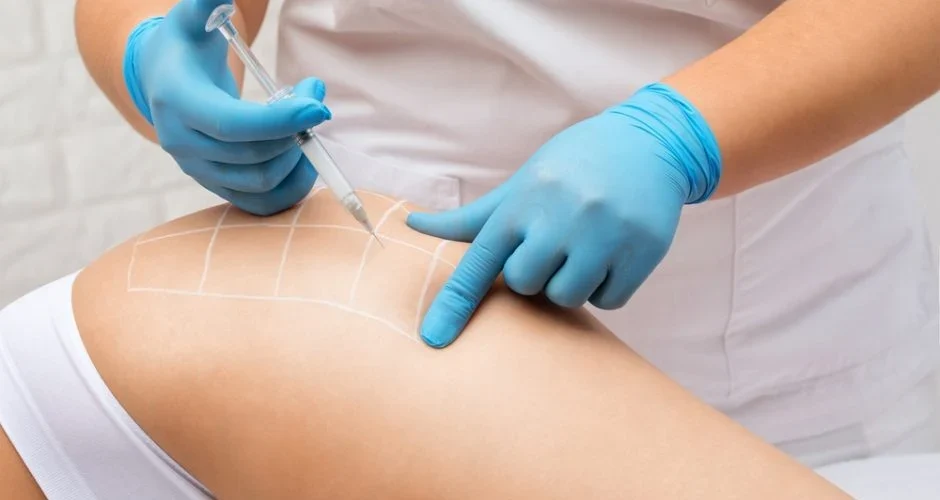 Image via Lumadoc
Ireland Fashion Week Attendees Received Vouchers Redeemable on Fat Dissolving Treatments at Body-Inclusive Designer’s Show
Text: Izzy Copestake
… Without the designer’s knowledge.
Ireland Fashion Week, powered by Visa, drew to a close this week, but questions have emerged over the distribution of vouchers redeemable at Lumadoc, an Irish aesthetic treatment clinic. These vouchers, redeemable against all of the clinic’s treatments and products, including fat-dissolving treatments, dermal fillers, and botox, were given to Ireland Fashion Week attendees at some of the events. Significantly, the vouchers were made available to attendees at a presentation by a designer renowned for radically inclusive and body-positive showcases, Irish designer Sinéad O’Dwyer. District have discovered that this occurred without her knowledge.
District attended Sinéad O’Dwyer’s show as part of Ireland Fashion Week on Friday the 9th of October. As expected, the show was nothing short of breathtaking. Situated under the ancient ceiling of Dublin City Hall, models glided and crawled around the circular runway, wearing designs which explored the tension between structured tailoring and stretchy, frilled, romantic details.
O’Dwyer is undeniably one of the most inclusive designers of the moment. She has cast disabled models in her shows, given an interview in Vogue on “Why Body-Diverse Casting Needs To Become The Norm At Fashion Week”, and SHOWstudio has said that Sinéad O’Dwyer is a designer “whose eponymous brand rejects fashion’s toxic tradition of the sample-size body.”
What O’Dwyer has achieved in five years is revolutionary. In true Sinéad O’Dwyer style, the models cast for the Ireland Fashion Week show were incredibly diverse in body shape and size. After the show, attendees were given goody bags containing the likes of L’Oreal hair products, makeup, fake tan and more. However, the inclusion of a €100 voucher for Lumadoc, felt distinctly at odds with the ethos of the show.
Lumadoc describes themselves as a “clinic, which is doctor led and patient first”. While Lumadoc has a shop section on its website which features skincare products, the vouchers were not limited to these items and could also be used towards procedures that raise questions in the context of a body-inclusive fashion show. For example, in the face and skin section of their treatments page, the first three treatments listed are “anti wrinkle injections”, “dermal filler” and “fat dissolving”. According to the Lumadoc website, abdomen fat dissolving “reduces stubborn belly fat deposits without surgery, helping contour and slim the midsection for a more defined shape.”
District contacted a representative from Lumadoc to confirm what the vouchers could be used for. They confirmed that the vouchers could be redeemed against any treatment or product offered by the company, including skincare products, dermal fillers, fat-dissolving treatments and anti-wrinkle injections.
In light of this, District reached out to the team at Sinéad O’Dwyer, who confirmed that the brand had no knowledge or involvement in the gifting, but declined to comment further on the matter.
Significantly, these vouchers were not present at every Ireland Fashion Week event. Lumadoc confirmed to District that vouchers of varying values were included in goodie bags at several designers’ shows, ranging from €50 to €100. In terms of standalone shows, Sinéad O’Dwyer and Mná received €100 vouchers, while those attending Aoife McNamara’s show received €80 vouchers and Brother Wolf’s attendees received €50 vouchers. Attendees of the group show under the banner of ‘Irish Roots’ also received a €100 voucher.
District reached out to the designers who had standalone shows in which the voucher was given to establish whether they had been made aware of the vouchers in advance, and whether they had been consulted about their inclusion in the goodie bags. At the time of publication, the designers had not responded to District’s requests for comment.
This situation raises questions about transparency around sponsorship and promotional partnerships at Ireland Fashion Week, and the extent to which designers have a say or are made aware of the products and services promoted to audiences at their shows, particularly when it is possible to redeem these vouchers on treatments such as fat-dissolving and dermal filler.
In light of this, District asked Ireland Fashion Week how its partnership with Lumadoc came about, who made the decision to include the vouchers in attendees’ goody bags, and whether designers had been informed in advance of their distribution. District also asked which shows the vouchers were distributed at, and whether the promotion of aesthetic treatments had been considered in the context of body inclusivity.
In response, Ireland Fashion Week explained that Lumadoc was its backstage skincare partner, and the role of the partnership was to prepare models’ skin backstage. Ireland Fashion Week also said the partnership helped provide backstage opportunities for beauty professionals across Fashion Week.
However, this response did not address the fact that these vouchers were redeemable on procedures like fat dissolving and dermal filler, clarify how the decision to distribute the vouchers came about, who authorised their inclusion in the goody bags, whether designers had been informed or consulted in advance, or which shows had received them. It also did not address whether the promotion of fat-dissolving treatments, dermal fillers and anti-wrinkle injections had been considered in the context of body inclusivity.
Ultimately, this is not about aesthetic treatments in isolation, or even the decision to partner with Lumadoc as an official skincare sponsor. It’s about what happens when corporate sponsorship contradicts the very core of what the creative’s work stands for. It raises questions about the implications of associating groundbreaking Irish body-inclusive designers with businesses promoting treatments that can reinforce patriarchal beauty standards, particularly when those designers are not made aware of this association.


