The Story Of The All-Women Cult From Donegal Who Pioneered Video Game Design
Established in 1982, the Silver Sisterhood was a new religious movement, often described as a cult, whose membership consisted predominantly of women. The group rejected many aspects of modernity, promoted a matriarchal society and, unusually, became involved in the creation of video games.
The group arrived in Burtonport, County Donegal, in September 1982. They lived in a large house that had previously been occupied by the Atlantis commune, known locally as “the Screamers”. The Silver Sisterhood initially renamed the property An Droichead Beo, meaning “The Bridge of Life”. The community lived without electricity or modern appliances, worshipped God as a feminine deity and sought to establish a matriarchal way of life. Although men could become members, the community was overwhelmingly female.
The group also operated a tearoom from the house and produced crafts as part of an attempt to support themselves financially.
Members of the Sisterhood could be identified by their distinctive old-fashioned clothing. In their early years, they wore full-length dresses, shawls and head coverings, while Victorian-style clothing became increasingly associated with the group later on. They viewed much modern technology and materials, particularly plastics, as spiritual or environmental “pollutants”.
In 1984, the community was transformed into St. Bride’s School, offering adult women the experience of attending an old-fashioned English boarding school. Visitors could spend their holiday following school routines, lessons and rules while dressed in period clothing.
An article described St. Bride’s as:
“a surreal holiday where grown-up women relive their childhood fantasies by dressing up in pinafores and bonnets and going back in time to a 20s boarding school.”
As another source of income, St. Bride’s began producing computer games. Although the group rejected much modern technology, they valued computer games because they required “concentration and commitment”.
Their first game was the text adventure The Secret of St. Bride’s, released for the ZX Spectrum in 1985. It was followed by titles including The Snow Queen, The Very Big Cave Adventure, Bugsy and Jack the Ripper.
Their 1987 game Jack the Ripper was the first video game to receive an 18 certificate from the British Board of Film Classification.
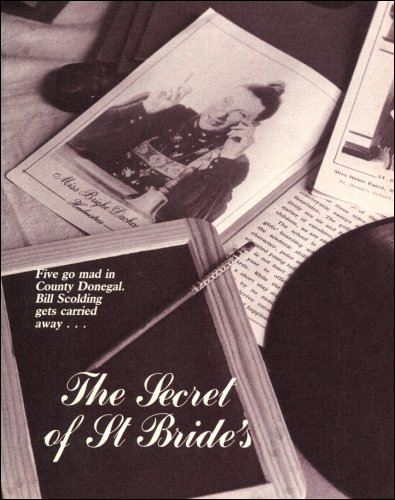
St. Bride’s is credited with eight released text-adventure games between 1985 and the early 1990s. Their games ranged from fairy-tale fantasy to comedy, historical settings and horror. The women behind St. Bride’s can reasonably be described as among the early pioneers of Ireland’s video game industry.
The group left Burtonport in 1992, with members subsequently relocating to Oxford and later to the Whipps Cross area of London.
The last that was heard of the group was a logging on a ZX Spectrum website for a game called ‘Wondergirl’ that was neer released.