This Report Reveals How Digital Life, Pornography and More Impact Student Relationships

Words: Izzy Copestake
Nothing’s worse than experiencing something tough and feeling alone in your experience. So we’ve teamed up with TU Dublin to bring you the findings of the Feel Seen Report and shed some light on students’ experiences across the country.
This report, which surveyed 330 students across twelve Irish higher education institutions, looks at everything from consent and healthy relationships to sexual harassment, online pressure and why so many students find it difficult to speak up.
Some of the findings in this report might be tough to read, but they are so important to understanding the culture that students across the country are navigating every day.
Download the full report here.
Healthy Relationship Dynamics Are Often Missing From Student Culture
The research highlighted a key paradox: students demonstrated an extensive knowledge and desire for healthy relationships and dynamics which champion respect and consent, but often these pillars were reported missing from everyday student culture.
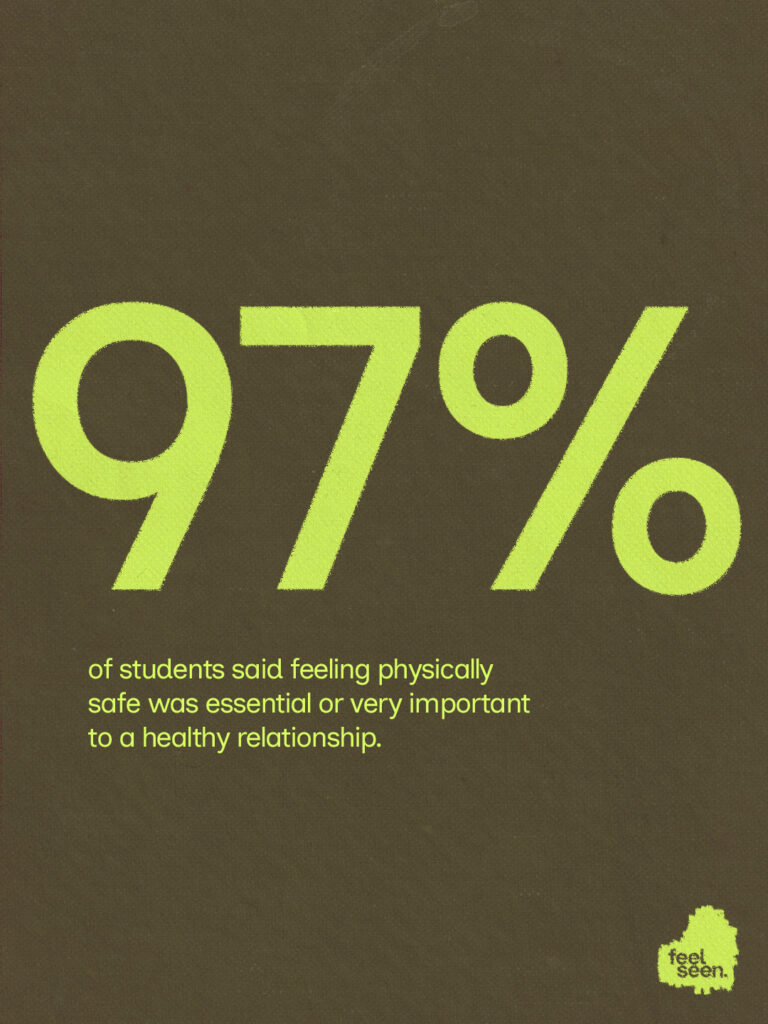
More than nine in ten students said that feeling physically safe (97%), being able to say “no” without guilt, pressure or fear (96%), and being respected even when they disagree (96%) were either essential or very important to a healthy relationship. Emotional safety (95%), open communication (95%) and being able to disagree safely without fighting (94%) were similarly prioritised.
However, many of these pillars were also among the aspects of relationships that students reported as most often missing or hardest to find. Over half of those surveyed (55%) said that being able to say “no” without pressure or guilt was often missing or hardest to find. Students also reported being respected when you disagree (42%), being able to disagree safely without fighting (39%), and having independence (37%) as traits which were most often missing or hardest to find.
Similarly, the culture that students experience, both online and offline, on a day-to-day basis demonstrates that many of these ideals are still missing. Since starting college, 41% of students reported experiencing unwanted sexual comments about their body, appearance or private life, while 34% had experienced unwanted digital or online contact, such as persistent messages, unsolicited explicit images or online stalking.
Almost three in ten (29%) reported unwanted touching or groping, while 18% said they had been pressured or coerced into sexual activity despite saying “no”, showing hesitation, or simply to keep the peace. Most significantly, 11% reported experiencing non-consensual sexual activity, including activity that happened without their consent or when they were unable to consent due to alcohol or drugs.
Digital Life is Intensifying These Pressures
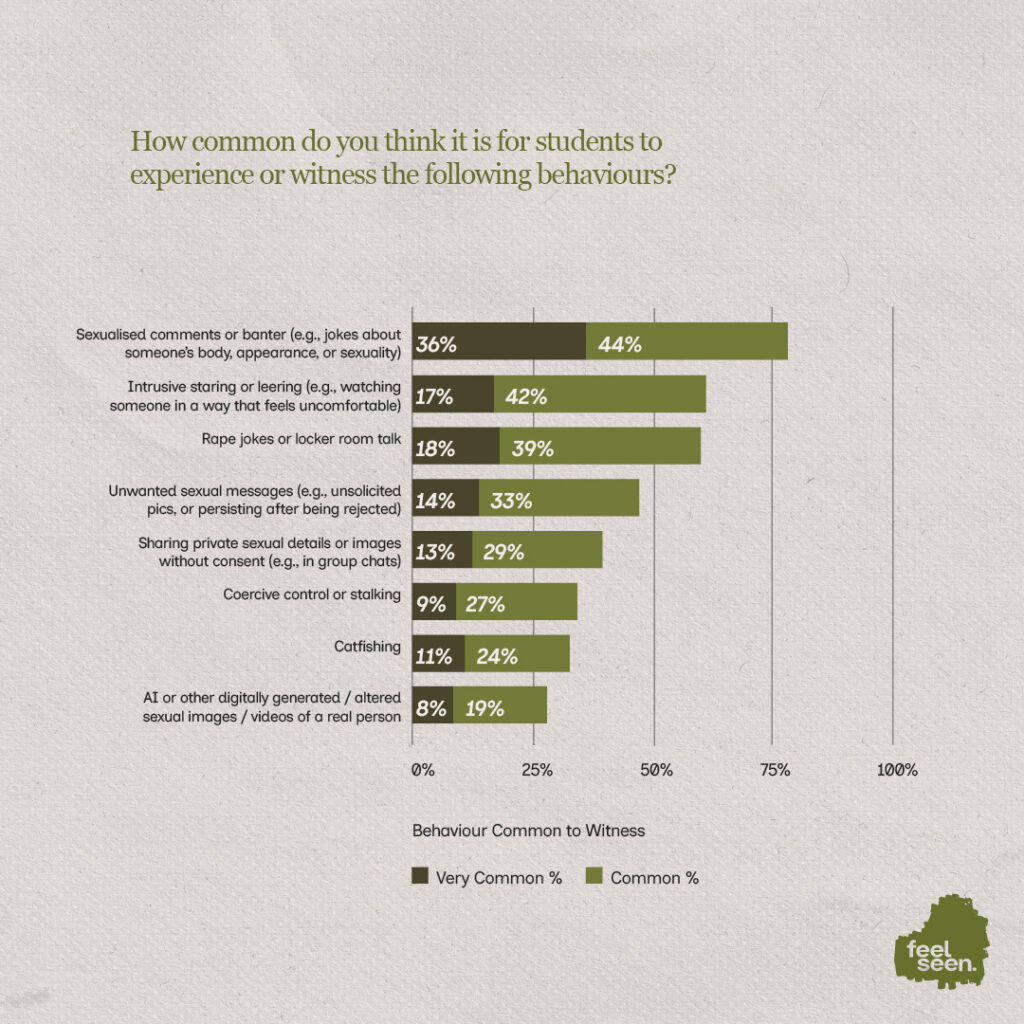
The research found that online environments do not simply reproduce offline relationship dynamics, but magnify them through speed, visibility, permanence and circulation, making surveillance, pressure and sexual boundary violations harder to escape. Students see these behaviours as widespread: 80% said sexualised comments or banter are very common or common among students, 59% said the same of intrusive staring or leering, and 57% of rape jokes or “locker room talk”.
More explicitly digital-only harms were seen as part of the same culture, with 47% saying unwanted sexual messages are common, 42% saying the same of private sexual details or images being shared without consent, 36% of coercive control or stalking, and 27% of AI-generated or altered sexual images of a real person. What makes the digital element so damaging, students explained, is that control is almost impossible to regain once material is out. “By the time the user is notified that the image has been saved or shared, it is too late,” one female student said, while another noted that people may feel sick when they see a shared image but “won’t necessarily report it unless they are the victim.”
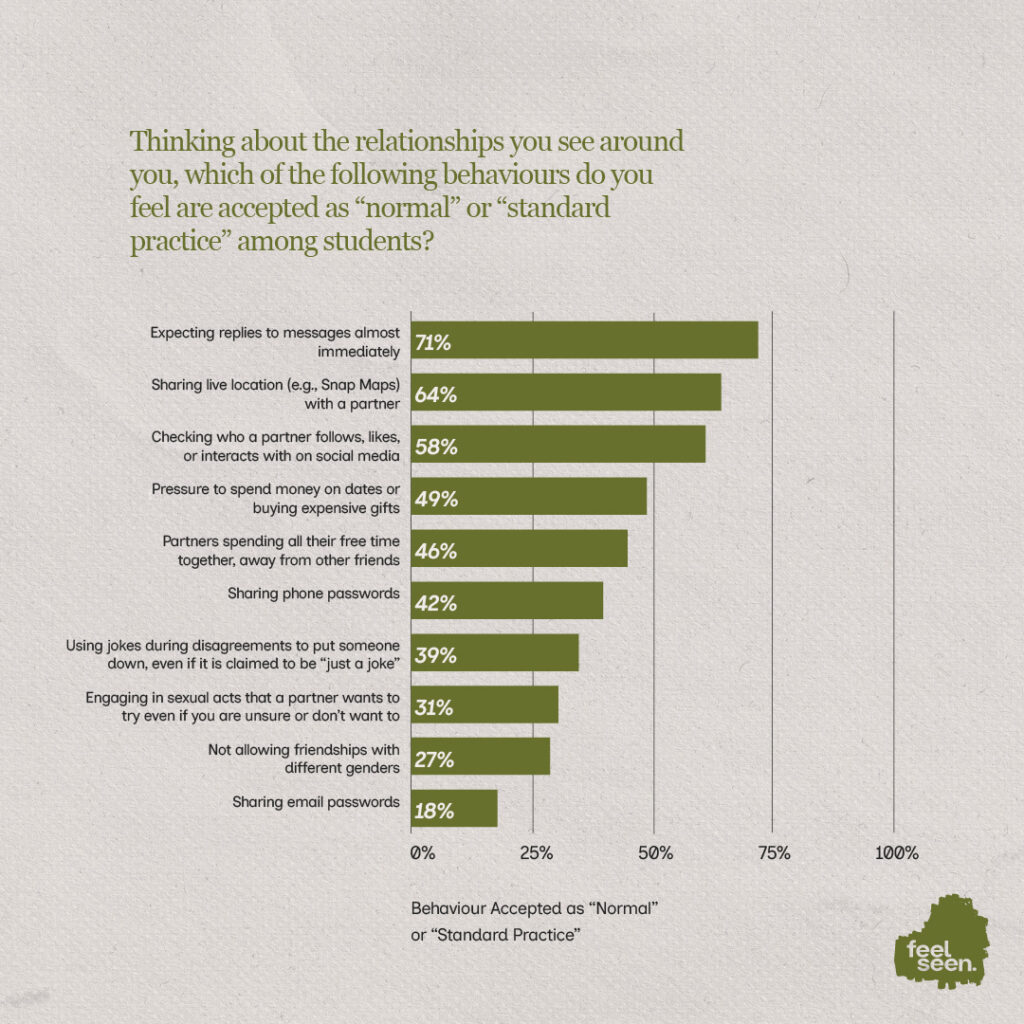
The research also showed that behaviours linked to pressure, surveillance and control, particularly within online spaces, were often deemed as normal by students. When asked about the relationships students see around them, 71% of students said it was normal to expect an immediate reply from a partner, while 64% considered live location-sharing with a partner to be normal, and nearly 6 in 10 (58%) considered checking who a partner follows, likes or interacts with online to be normal.
The research found that behaviour that might begin to feel uncomfortable to the student on the receiving end of it, often arrives using language that feels protective or affectionate, rather than harmful.
As one anonymous female student puts it in the report, “The constant texting/checking in and the isolation,” one student explained in the survey. “We tell ourselves they are just ‘really into us’ or ‘protective’ because of past trauma. We normalize it as a sign of how much they care, rather than a lack of respect for our autonomy.”
“We normalize it as a sign of how much they care, rather than a lack of respect for our autonomy.”
The language used to describe the uncomfortable behaviour also was shown to soften the seriousness of it. “Terms such as “clingy,” “protective,” “just insecure,” or “really into you” reduce urgency and make challenging the behaviour feel socially excessive”, the report reads.
The report also highlighted that while individual behaviours may feel manageable in isolation, repeated jealousy, possessiveness, or monitoring “can produce relationships in which one person feels emotionally exhausted, monitored, restricted, or less free than before.”
Pornography is Creating Harm
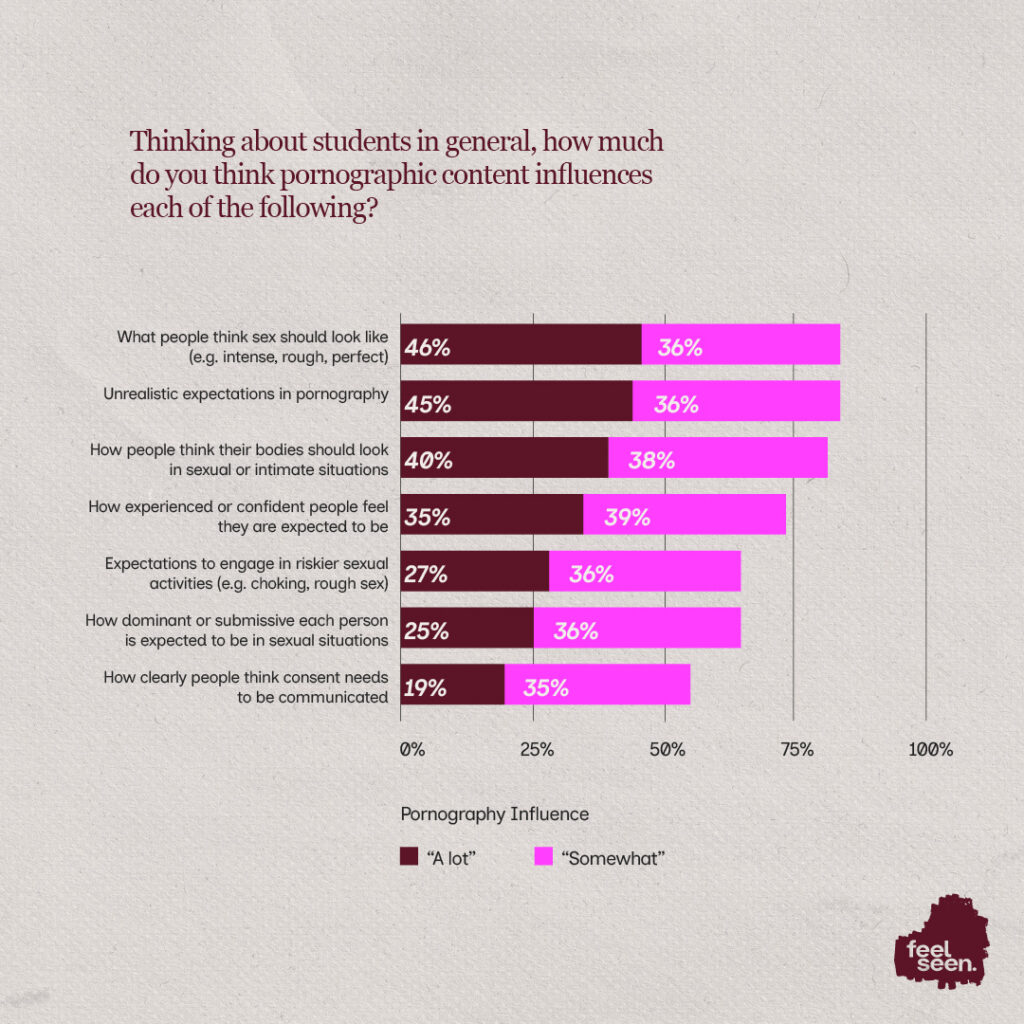
Another key area where the online world was demonstrated to impact relationships was in pornography. When asked how much porn impacts what sex should look like in relationships (e.g. intense, rough, or perfect), 82% answered that it somewhat does, with 46% of this cohort stating it impacted it “a lot”. Notably, more than 6 in 10… 63% said that porn somewhat influenced expectations to engage in riskier sexual activities such as choking or rough sex, with 27% saying it influenced it “a lot”.
Difficulty in Calling Harm Out
Students do not feel empowered to speak up against harm, particularly when it happens in group situations. When unwanted comments, touching or staring occur in group settings, 43% of students say the most common response is for people to stay quiet or ignore it. A further 27% say students tend to laugh it off or treat it as banter. Together, this accounts for 70% of responses. Only 9% of students identify someone directly calling it out in the moment as the most common response.
The report highlights that laughter can function as a way of reducing awkwardness, avoiding escalation or maintaining group cohesion, rather than support of the uncomfortable behaviour. Similarly, staying quiet may reflect uncertainty about whether the behaviour is serious enough to challenge, rather than a belief that it’s acceptable. However, laughter can normalise this behaviour, unintentionally or not.
As one research participant explained it, “It’s not ‘just a joke’ or ‘banter’ if it makes someone feel unsafe.”
“It’s not ‘just a joke’ or ‘banter’ if it makes someone feel unsafe.”
The report reads, “Socially available explanations — “just banter,” “they’re protective,” “it’s not that deep,” “they were joking” — usually arrive faster than the language needed to challenge behaviour publicly. The issue is therefore not simply whether students recognise harm. It is that harmful behaviour often remains socially interpretable as something else first.”
There are Barriers to Students Getting Help
The report also highlights the systemic barriers that prevent students from reporting sexual violence or seeking support. When asked why students might choose not to report an incident, 68% cited concerns that they would not be believed, taken seriously or that nothing would change. A further 63% pointed to fears of gossip, drama or damage to their social relationships, while 59% worried that the person involved would find out.
As the report explains, “Formal systems are often perceived as exposing, procedural, and difficult to control. As a result, many students remain within informal support networks for as long as possible before approaching institutional pathways.
The issue is therefore not simply whether support exists.
It is whether support feels enterable at the point where
uncertainty, fear, and social risk are already at their
highest.”
If you have been affected by the subject of this article, supports are available from:
- HEI Student Support Services and Student Union Offices
- Speakout.ie
- Dublin Rape Crisis Centre
- SATU.ie
- alwayshere.ie
- toointoyou.ie
- Womensaid.ie
- mensaid.ie
- The Samaritans 24 hour free telephone line on 116 123
- Pieta House: 1800 247 247
- Gardai/Fire/Ambulance : 112/999
This report, which surveyed 330 students across twelve Irish higher education institutions was funded through the Higher Education Authority (HEA) EDI Ending Sexual Violence and Harassment National Awareness Campaign Fund, and was conducted in two phases. These were an anonymous quantitative survey of 330 students between February and March 2026, followed by a qualitative online research community involving 25 students in April 2026. This ongoing campaign has been further funded by CUAN, the National agency for Domestic, Sexual and Gender-Based Violence.