On The Ground at The Twelfth
By Seán Óg Ó Murchú
Photography by Seamus Murphy
What follows is a first-hand report from Belfast-based Irish writer and journalist Seán Óg Ó Murchú, who was on the ground as violence unfolded across the city yesterday. Ó Murchú and Seamus Murphy, an internationally recognised Irish documentary photographer and filmmaker, documented the events over the weekend.
The Twelfth of July celebrates King William of Orange’s victory at the Battle of the Boyne in 1690, which secured the Protestant Ascendancy in Ireland and ensured the oppression of indigenous Irish Catholics. Celebrations today consist of days of drinking and, for some, narcotic abuse as the fires burn and marches descend on the streets. Pallets are collected in the spring, and with them, pyres are constructed, towering above Unionist communities, often dangerously close to homes and, in some cases, sites containing asbestos.
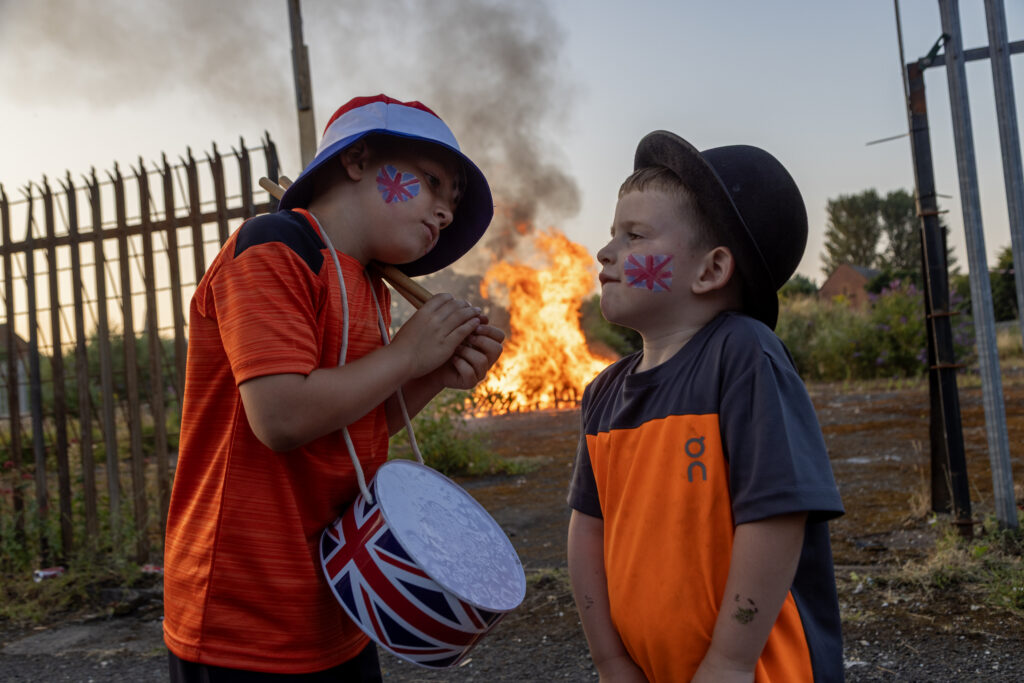
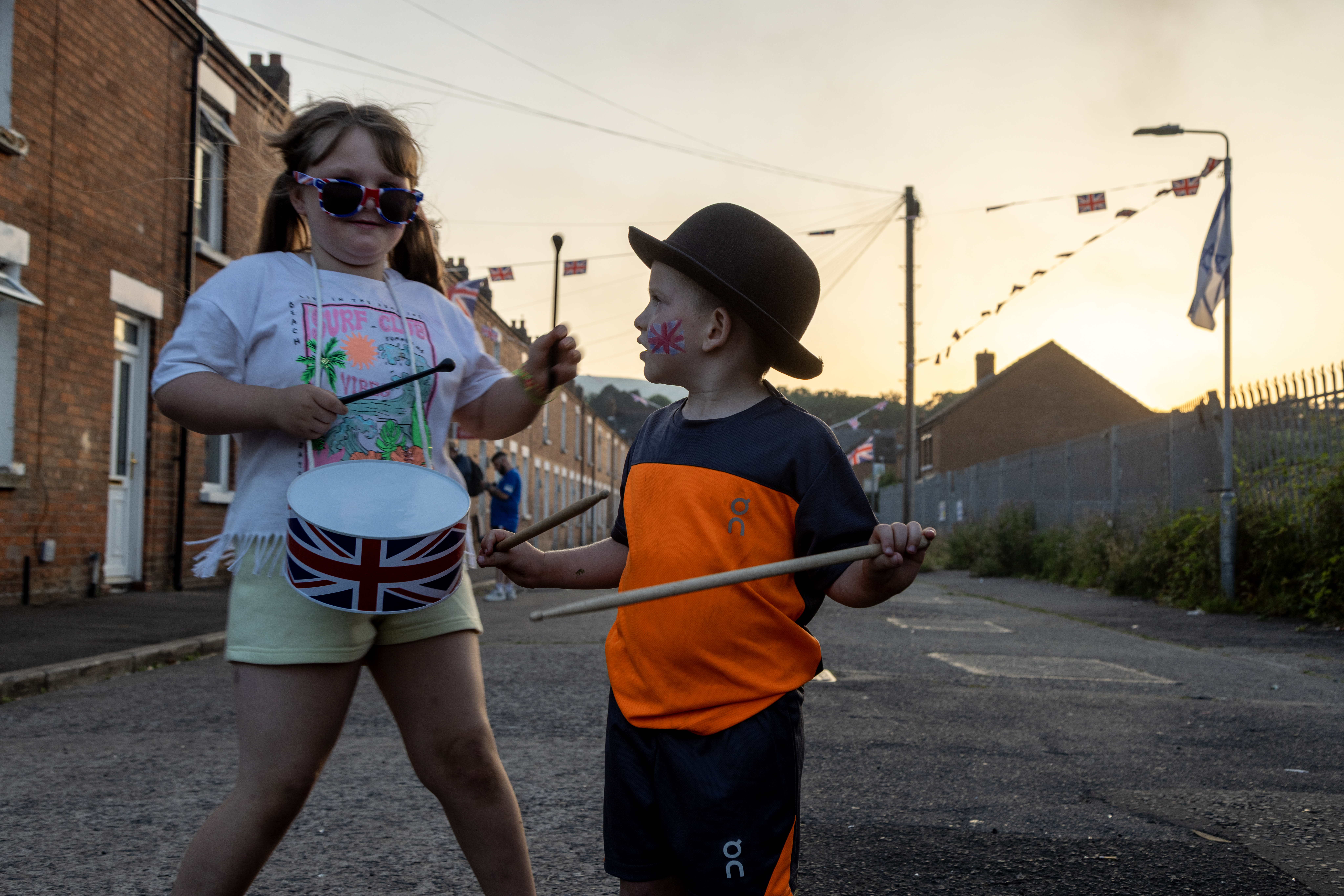
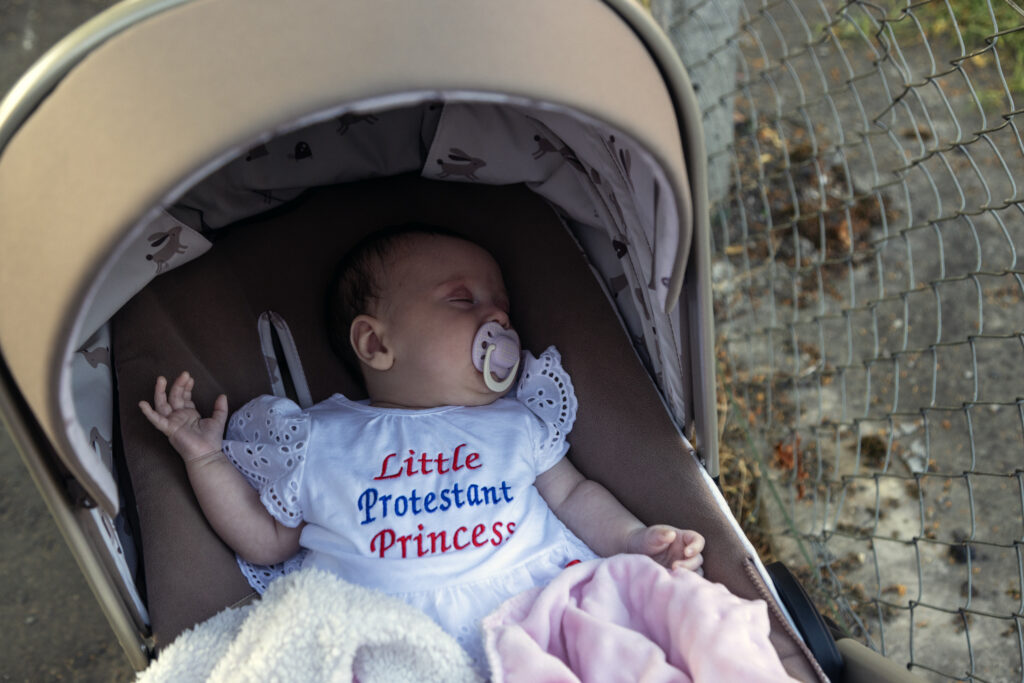
Woodvale, off the Shankill Road. Children prepare for the upcoming festivities
After the burning of these pyres, which in most cases are adorned at the time with Irish tricolours, images of Republican politicians, and other various offensive materials, marching bands parade throughout the occupied six counties the following day. The result being a sordid mess for local councils to clean from the streets. The event is organised mainly by the Orange Order, a conservative, sectarian fraternal organisation in place to maintain and solidify Protestant and Unionist hegemony. It is a contentious holiday, despite recent efforts being made to reframe it as a family day out. For Irish people in the six counties, it is a reminder of the hatred that some Loyalists still hold for the indigenous population of Ireland.
Furthermore, Far-Right elements of Unionism, which produced race riots and pogroms in Belfast last month, have taken the Twelfth in a chokehold. The hatred that many Irish people have become accustomed to on the Twelfth is now being directed at ethnic minorities. This was evident on July 10th, when a replica of a mosque on top of a bonfire in Moygashel, in the county Tyrone, was lit early in advance of a planned police operation to remove the inflammatory structure. Banners below it read, ‘SECURE OUR BORDERS’ and ‘END THE THREAT OF RADICAL ISLAM’.
What gives Unionism so much agency during this period is the refusal from both the British and Irish states to engage or effectively regulate their actions; therefore, it is, I believe, crucial for citizens of both states to observe the chaos that the six counties suffers every July. With this in mind, I met with the acclaimed documentary photographer, Seamus Murphy, to collaborate on a report on the Twelfth of July celebrations 2026.
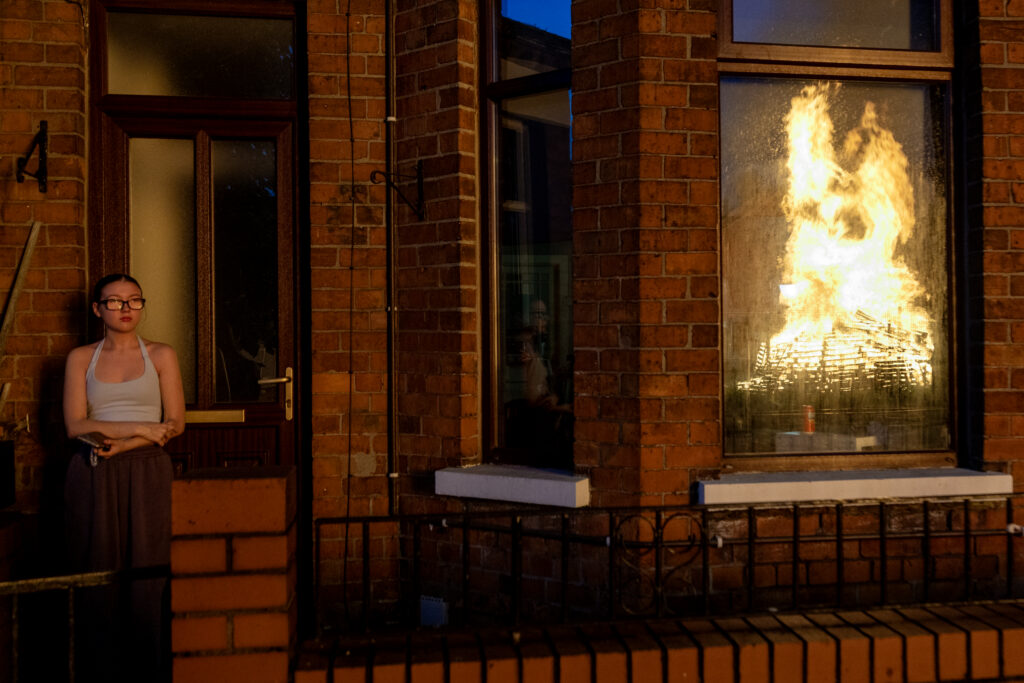
A resident watches a bonfire across from her home
Day One, July 11th
7:00pm, Victoria Park, East Belfast:
The pyre before me in Victoria Park had a few custom tricolours on top, along with a pair of Starry Ploughs and a flag belonging to the Republican political group, The 1916 Societies. I was with two other journalists, both of whom had cameras around their necks, which prompted an inspection from two middle-aged men asking who we worked for. We told them we were freelancers, which was true for only some of us. One of the men, deeply suspicious, said then that the last fella who said he was a freelancer, in fact, turned out to be with the Irish News. This, to the Loyalist, seemed an abhorrent paper to work for. We assured them this was not the case for ourselves, and when we left to pick up another colleague, I advised it might be best to leave the press passes in the car for the night.
One of the men, deeply suspicious, said then that the last fella who said he was a freelancer, in fact, turned out to be with the Irish News. This, to the Loyalist, seemed an abhorrent paper to work for.
7:20pm, Sandy Row, South Belfast:
On Sandy Row, the geographical nucleus of the Twelfth celebrations, men in Linfield F.C. and Rangers jerseys could be seen drinking beer and cider from plastic cups on the street outside the Royal bar and the Rangers club; women lounged with wine and alcopops in their Union Flag-draped gardens, and children played up and down the road. On the fencing surrounding the bonfire site, a white sheet was hung depicting the Star and Crescent inside a prohibition sign. While we inspected the pyre, a man beckoned us to his car and told us that the Loyalist stronghold in South Belfast known as the Village had built the tallest bonfire in ‘northern Ireland’.


8:00pm, The Village, South Belfast:
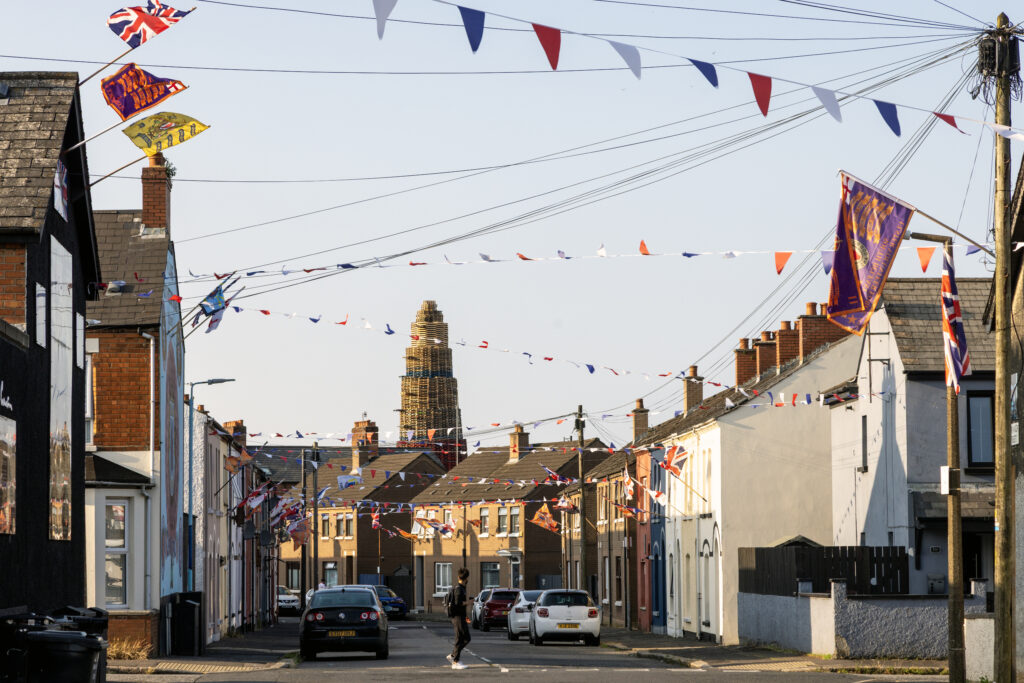
On the way, the Village’s pyre poked out over the city skyline in front of us. The heap was indeed massive. The biggest? Difficult for me to say, but a man who told us he oversaw its construction claimed it was up to two hundred and forty feet high. He beamed with pride when telling us of the children who had been climbing the structure, putting it all together. This particular pyre was due for burning at midnight on the 12th. Traditionally, it would be the 11th night, but with the 12th falling on the Sabbath this year, festivities, per se, were extended, with two bank holidays due for the Monday and Tuesday following.
He beamed with pride when telling us of the children who had been climbing the structure, putting it all together.
9:00pm, Woodvale, West Belfast:
A mini bonfire had been lit just off the Shankill Road. Outside the gates concealing it, drunk parents posed for photographs with their kids, who were kitted out in red, white, and blue bucket hats, drums, and batons. One child wore a little black, orange-order style, bowler hat and had a Union Flag painted on his cheek. He was, frankly, adorable, and I had complex thoughts watching such innocent, endearing little children so full of joy and excitement in the wake of a festival celebrating the colonisation of myself and my ancestors.
He was, frankly, adorable, and I had very complex thoughts watching such innocent, endearing little children so full of joy and excitement in the wake of a festival celebrating the colonisation of myself and my ancestors.
10:00pm, Cregagh, East Belfast:
At the Cregagh bonfire site, we were once again asked who we worked for. As long as we weren’t Irish News, we were okay, but if we were, we could ‘fuck off’. A street sign for Knock Eden Park, containing the translation as Gaeilge (Páirc Chnoc Éadain), was then placed on the pyre. The young man who put it there told us not to photograph his face, as he had a job interview coming up.
A street sign for Knock Eden Park, containing the translation as Gaeilge (Páirc Chnoc Éadain), was then placed on the pyre.

00:00am, Ravenhill, South-East Belfast:
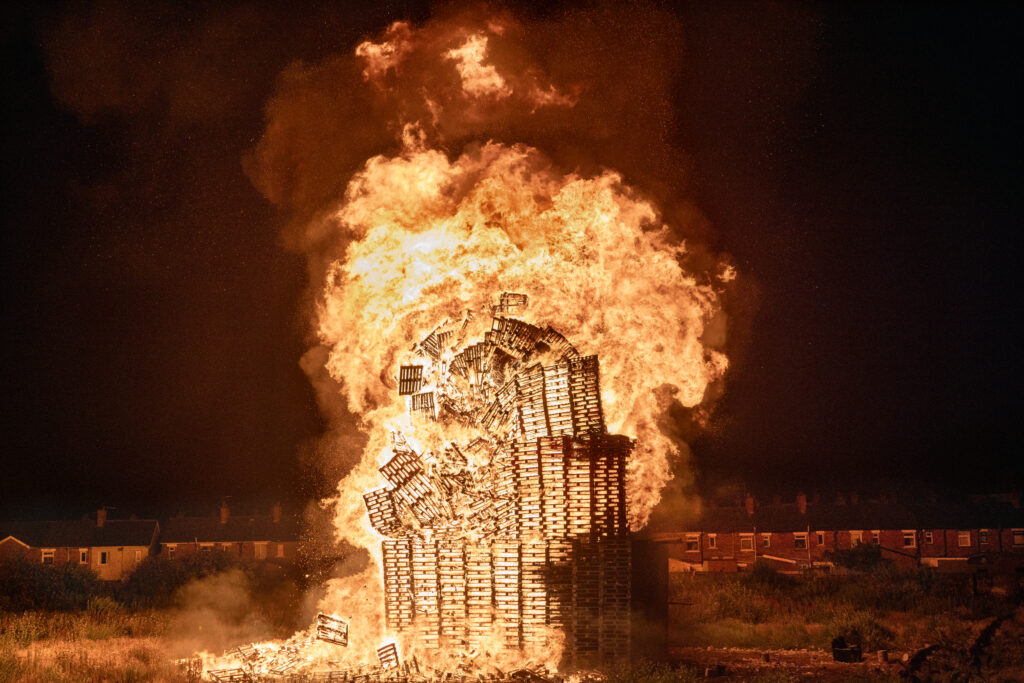
Colossal flames wrapped themselves around the pallets from inside of the Ravenhill Bonfire, turning the flag of my nation to dust. Young crowds gathered on Lismore Street, observing the inferno, partying, as EDM blared from the end of the road and the structure, as they so often do, collapsed in on itself. Toward the bottom of London Road, I had to put on my sunglasses for the heat of the fire against my eyes, as the fire service sprayed down the surrounding houses to keep them cool.
Colossal flames wrapped themselves around the pallets from inside of the Ravenhill Bonfire, turning the flag of my nation to dust.


Day 2 July 12th
2:00pm, Holywood, North-West County Down:
The following afternoon, I took myself for a walk along the beach to get some peace from the city. During my walk, I passed graffiti declaring ‘White Power’ and an ode to Enoch Powell, the Far-Right extremist, alleged paedophile, and mentor to former first minister of the occupied six counties, Sir Jeffery Donaldson, who himself has recently been convicted of historical sex crimes involving children.
11:20pm, The Village, South Belfast:
We passed through a large gate keeping the growing crowds on Monarch Parade at a safe distance and were met immediately by organisers telling us we weren’t allowed to be there. Then, of course, came the questions about who we worked for. This time, it was the Sunday World we had to deny were our paymasters. Fortunately, we spotted a colleague who had been granted access, and his good word was enough to convince the organisers to allow us to stay.

Twenty minutes before midnight, the man who had bragged to us the day before about the height of the structure, and the weeains who had built it, began, amazingly, to climb the bloody thing from the bottom up. I watched in disbelief as this fella, with no helmet or harness, or any form of safety equipment at all, got himself to the top of the pallets to set them alight. Before the fire, the black sky above me was lit by the various, excessive array of light and sound from a ten-minute-long firework display, echoing through the dead night. As the flames at the top of the structure became visible, and the pyre became a bonfire, the man at the top began to come down.
I watched in disbelief as this fella, with no helmet or harness, or any form of safety equipment at all, got himself to the top of the pallets to set them alight.

I had to admit, between the fireworks, the burning, and the successful descent, it was a sight to behold. I even clapped along with everyone else, as the man’s feet touched the occupied earth, although this was heavily influenced by a desire not to stand out or blow my cover as a Pope-loving Fenian bastard. Before long, the front of the bonfire was engulfed entirely, and we made our way out of the site by the entrance at Maldon Street.
I even clapped along with everyone else, as the man’s feet touched the occupied earth, although this was heavily influenced by a desire not to stand out or blow my cover as a Pope-loving Fenian bastard.

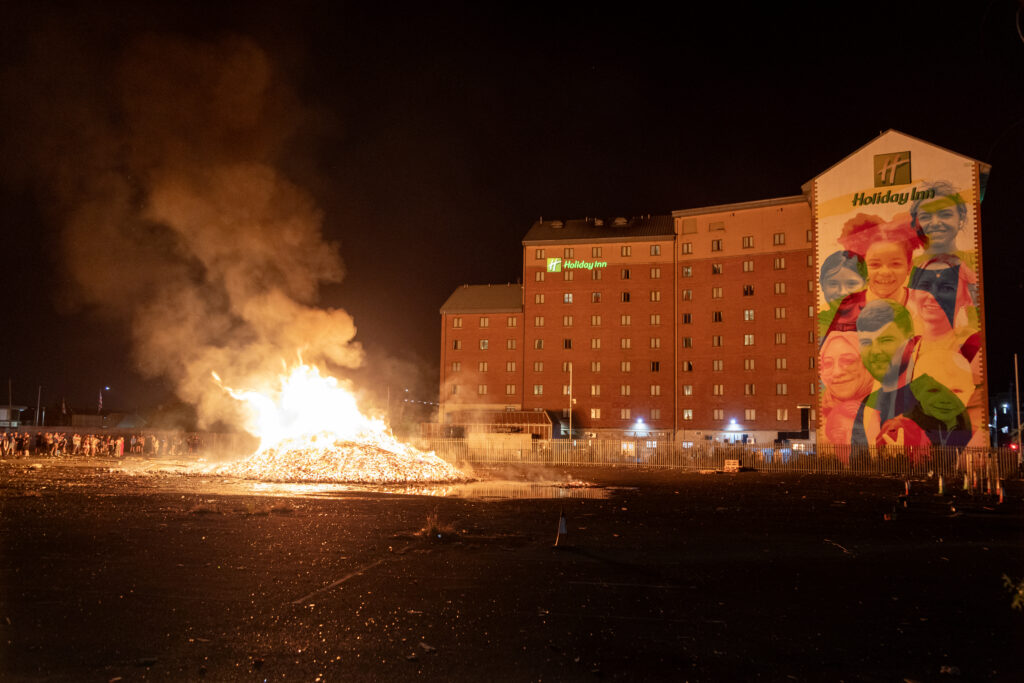
At twenty-five past twelve, just twenty minutes after it had been set alight, the Village bonfire collapsed in the direction of Lower Rockview Street. I made my way then back to Monarch Parade, where several fire service units had been deployed to keep the Loyalists away from the fire, and the surrounding houses from overheating. The streets were drenched with the water bouncing off orange brick, soaking my cigarette as I watched residents being evacuated from their homes.
Several fire service units had been deployed to keep the Loyalists away from the fire, and the surrounding houses from overheating

1:10am, Sandy Row, South Belfast:
The Sandy Row bonfire was by then a small but lively mess. There was a large crowd partying around Wellwood Street, but I hung around the fire, my interest piqued by a group of young men with French accents chanting ‘Antifa Terrorists’. Before long, these fellas themselves took interest in a colleague and me, with them eventually accusing us of being Antifa (anti-facist) terrorists.

My colleague managed to placate them a small bit, and they warmed to him, but for reasons unknown to me they refused to believe that I wasn’t a so-called terrorist. It was when one of these men, who I later discovered was in fact a Scottish fella, gave me the cutthroat gesture that my colleague and I decided it was too dangerous to stay- time had come to leave as quickly as possible.
It was in the car on the way home that I pondered on the brazen nature of this behaviour. I am white, I have a Belfast accent; for all these men knew, I could have been Officer Commanding of the Sandy Row UVF, and they’d have been none the wiser. I found this interaction particularly peculiar, and, unfortunately, it wouldn’t be the last instance of French Far-Right thuggery over the long weekend.
I am white, I have a Belfast accent; for all these men knew, I could have been Officer Commanding of the Sandy Row UVF

Day Three, July 13th
12:30pm, Shaftsbury Square, South Belfast:
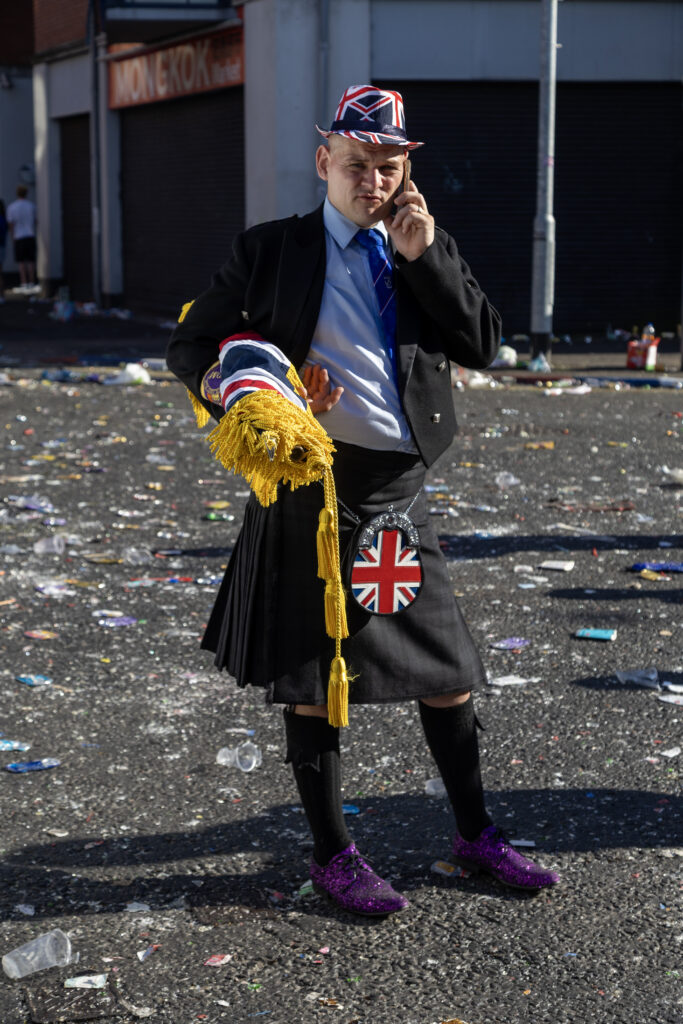
Monday then, Seamus and I were surrounded by thousands of Loyalists, jubilant still from their three-hundred-year-old victory in the County Meath. The Dublin Road and Bradbury Place were lined with deck chairs, running all the way up the Lisburn Road. Sitting in them, older women and children, waving plastic Union Flags, looking very British indeed, as marching bands passed, beating drums and blowing pipes in that regimented, militaristic fashion they are accustomed to. Seas of red, white, blue, and orange danced and sang along enthusiastically to The Sash my Father Wore, the drink beginning to get the better of some of them.
Seamus and I were surrounded by thousands of Loyalists, jubilant still from their three-hundred-year-old victory in the County Meath.


Following many of the bands were Translink buses. Although privately rented, it was hard not to notice that the public transport body was happy for their vehicles to feature in the big day of dominance and superiority- succinctly representing how the state facilitates the Twelfth. I thought then of the taxpayer. What does all this cost? Between public funding, the police and emergency services, the closed businesses, two bank holidays, and the countless people from Catholic/Republican and minority backgrounds who leave the six counties en masse at this time of year; surely this all leaves the statelet’s economy stagnant for the few days that are in it.

Seamus and I then followed the parade to Barnett Demesne, a field at the top of the Malone Road, where the bands and supporters rest before marching back to their respective Orange lodges.

5:30pm, Shaftsbury Square, South Belfast:
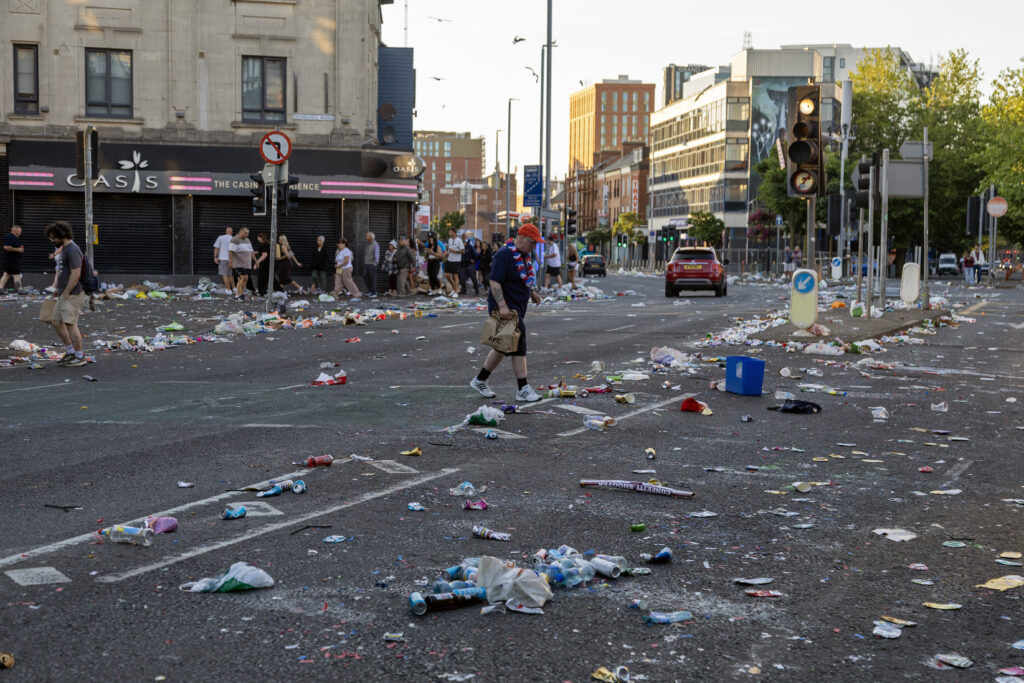
Huge crowds remained on the Lisburn Road, Great Victoria Street, and Sandy Row. The bands and supporters were even more lively marching back down the road, now after hours (days?) of filling themselves with drink. The streets were littered with smashed glass and rubbish.

A friend of mine, who lives on Victoria Place, then got in contact to make me aware of graffiti that had appeared on the walls of her apartment block. Upon investigating, I found one wall that read, ‘N*GGERS OUT’ and ‘P*KIS FUCK OFF’. This was, of course, horrific enough, but unfortunately overshadowed by the vandalism appearing on the wall next to it- my colleagues and I were stunned into silence reading, ‘GISÈLE PELICOT SALOPE FREE DOMINIQUE’.

In Avignon, France, in December 2024, Dominique Pelicot was sentenced to 20 years in prison for drugging Gisèlle Pelicot, his then-wife, and recruiting dozens of strangers to rape her. ‘Salope’ is a derogatory French word for a woman, translating to ‘bitch’ or ‘slut’. Throughout Sandy Row, more vandalism appeared, reading, ‘FRANCE LOYALS’ and ‘NORMANDY LOYALS 1066’. Later, in the Royal bar, I found another breadcrumb, a sticker reading, ‘LE PEN RANGERS FANS EXPATS 1066’ and depicting an image of Jean-Marie Le Pen, the founder of the National Front.
8:00pm, Albertbridge Road, East Belfast:
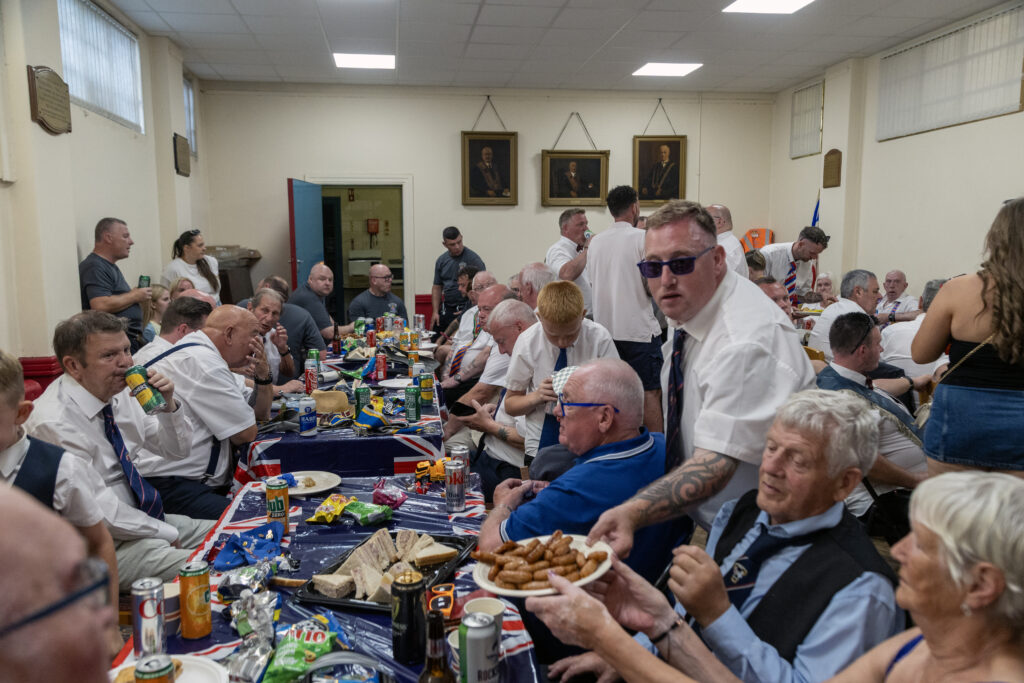
After visiting a quiet interface (a point where Catholic/Republican residencies meet Protestant/Loyalist/Unionist homes) at Short Strand, I found myself outside the Ballymacarrett Orange Hall. A documentary crew, who had been filming a particular Orangeman, had been granted access to the building, and Seamus and I had been mistaken for members of this crew, so I kept my mouth shut and my chest out as I walked into an Orange lodge for the first (and likely the last) time in my life. I had a great sense of having infiltrated the place, as members of the Orange Order filled me with cocktail sausages, sausage rolls, and cans of warm lager, and I wondered about the things these people might do to me if they had found out my name, where I was from, or what I do for a living.

Eventually, the jolly old Orangemen became too much to put up with. I was exhausted, mentally drained as I gave out my thank-yous and made my way out of the lodge, deciding to call an end to my investigation of the Twelfth. The keyword I had floating in my head then was ‘normalisation’. Hundreds of years of these people normalising this deeply abnormal event has drained me, as it has drained Belfast itself.

The worst part of the Twelfth is not any of the instances or events I have described in this report, as bad as some of them are; the worst part is the days after, when we must go back into work, when we must sit on the public buses that were utilized for the event, and share the seats with these people who hate us so much. We share our cities, towns, and villages with the people who burn our flag and religious symbols, who destroy our communities every year to remind us that we are (in their collective hivemind) subordinate.