Who Is Dingle For? The Tourism Boom Pushing Locals Out
Words: Luke O’Connell
Images via Unsplash
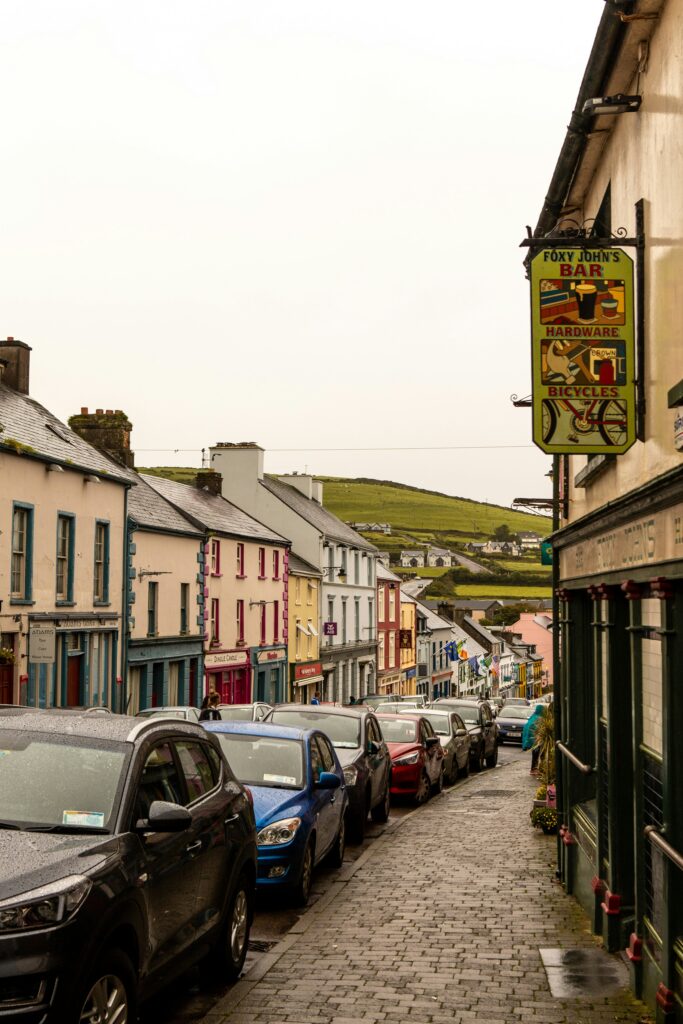
When people find themselves in Dingle’s vintage trinket shops and candlelit Kennedy’s pub, they’re in a place that cherishes its language, its music and its sense that it is untouched by commercialism. Nestled in the corner of the Wild Atlantic Way; Gaeilgeoirí, writers, artists and a certain magical spirit all collide in this rural arcadia. A town that was put on the map by a famous dolphin named Fungie, it is now wrestling with the consequences of its tourism success. By the nineties Dingle established itself as a haven for creatives, and now, for tourists
The irony is that the thing that is drawing tourists here, is the very thing being hollowed out. Open any short term-letting site and search for Dingle Peninsula, and you’ll find whitewashed cottages overlooking the Blasket Islands, town-centre harbour apartments and converted farmhouses on the winding roads of West Kerry. While there is an abundance of availability for tourists, there is little room left for locals.
Researcher Rob Cross recently mapped every short-term letting in the Dingle Peninsula. In Cross’ map, you can see red dotted houses that represent Airbnb accommodation around the peninsula. Twenty-six percent of houses on the peninsula are second or holiday homes.
In the Kerry Gaeltacht in August 2024, there were 543 properties listed on Airbnb and not a single house available to rent on Daft.ie at the same time. Kerry has 30 short-term lets for every one long-term rental, this was the worst ratio in Ireland, according to renter charity Threshold. Rents in Kerry rose 10.1% in the year to Q1 2025, almost double the national average of 5.5%.
Caught in this Airbnb induced squeeze are locals like Clodagh O’Sullivan and her fiancé Brady. Parents to two boys, they endured mould dripping down the side of their previous accommodation while Clodagh was pregnant with their first child. “Dingle is for tourists you know?” she says, “It’s as simple as that. It’s not for us at all.” Fortunate enough to fall back on a granny flat in her father’s house, they won’t give up. “It’s heartbreaking, it’s completely heartbreaking. It’s such a beautiful town and I really, really want the boys to grow up here.”
“Dingle is for tourists you know?”
Also caught in this is Edwin de Groot, owner of Dingle Printing. Originally from the Netherlands, he fell in love with the place on holiday and settled here with his wife to run his business. After 18 years in the same rented home, his landlord’s son needed somewhere to live, and Edwin had to move. From his garden, he can see nine derelict houses across the valley. “I think the biggest problem is years and years of no forward thinking by the government,” he says.
What is being lost goes beyond housing. Dingle is a Gaeltacht, one of the last functioning Irish-speaking communities in the country, and that heritage is central to what draws people here in the first place. Sinn Féin Councillor Robert Brosnan puts it directly. “People come to the Dingle Peninsula to enjoy our culture, our language, our living history, because we speak the oldest living language in Europe.”
“That’s why the Gaeileann’s and artists come to us, for that sustainable tourism.”
He added, “There are a lot of people that can’t find a place to rent in Dingle because it’s just all swallowed up by short-term letting.”
“There are a lot of people that can’t find a place to rent in Dingle because it’s just all swallowed up by short-term letting.”
Dr Aoife Granville, musician, lecturer, and Arts Council board member, has seen that erosion up close. Sitting at her piano, and showcasing her vintage bosca ceol, Aoife says, “It feels like people that are coming here sometimes don’t realise that people actually live here.”
“It feels like people that are coming here sometimes don’t realise that people actually live here.”
The local Fife and Drum band used to ring in the New Year on the town bridge. Bottles thrown and general safety concerns put an end to it due to a raucous crowd. “The New Year’s Eve parade was such a big part of our culture,” she says, “and that’s one of the first things that’s gone because of over-tourism.”
Aoife has also lived in Dingle long enough to see when it first became a haven for Irish artists. “You were meeting different creeds, different types of people, and it was hugely inspiring, and it brought a lot of other people here,” she says. Those type of people, she adds, cannot afford to move here today.”
Earlier this year, the government had a chance to act. New short-term regulations were set to require planning permission for Airbnb-style properties in towns with populations over 10,000. In February, after lobbying from Minister Norma Foley and Independent Michael Healy-Rae, they lifted the threshold to 20,000, exempting almost every rural tourist town in Ireland, Dingle included.
Kerry TD Danny Healy Rae, when asked about the crisis, told District his answer was a relaxation of planning laws. “I’m not going to criticise the tourism industry,” he says, “Dingle could be a quiet place if we didn’t have it.”
“I’m not going to criticise the tourism industry, Dingle could be a quiet place if we didn’t have it.” – Kerry TD Danny Healy Rae
Sinn Féin Councillor Robert Brosnan takes a different view, and puts it down to corporate greed. “A greedy element has crept into the whole thing,” he says. “There are corporations there that might have twenty Airbnbs, that’s not right.”
“A greedy element has crept into the whole thing. There are corporations there that might have twenty Airbnbs, that’s not right.” – Sinn Féin Councillor Robert Brosnan
Experience Dingle, which manages over 60 properties across the peninsula, sees it differently. “We don’t think Airbnb is the root cause of locals not being able to have housing,” a representative says. Their concern is what happens if the lets are restricted.
“If you were to close even 50% of the holiday homes, what sort of effect would that have on businesses in the town?” they ask. “If you closed a third of the Airbnbs, would they need the same amount of staff?”
Comedian and writer Julie Jay always dreamed of living in Dingle full-time having spent her summers here with her parents’ roots traced to West Kerry. During Covid, the chance came but finding housing almost derailed that dream.
“It really kills you when you’re outbid by somebody who is buying the property as an Airbnb,” she says. “You feel like, ‘Oh, I want to buy it because I actually want to live there.’”
She and her husband, Fred Cooke, eventually secured a mortgage, but not before sleepless nights as working parents.
While Dingle’s economy grows, some people are not enjoying the fruits of such successes. For now, the likes of Edwin De Groot are settling into his new accommodation, still in the scenic hills of Annascual and enjoying the view from his garden but a recurring thought won’t leave him.
“I’m not going to grow old here. I’m not going to be an old man looking at the field and thinking ‘Oh God, I remember my son flying a kite there when he was eight.'”