This Literary Salon Is Celebrating Queer Joy Through Gaeilge
Text: Leah Commandeur
Images: Aoife McGrath
The recent Irish language revival has brought new life to the Gaeilge once taught to us in school. What once was a just required subject for many young people, made difficult to access as a result of an outdated curriculum, is now being rapped, spoken by the country’s biggest stars and incorporated into our streetwear scene.
Or, for a growing community across the country, you can find it being spoken in LADTA+ (the Irish for LGBTQ+) spaces this Pride week and beyond. These spaces often merge queer community and Gaeilge together, like Salon Rógaire, Aerach Atach Gaelach, and a variety of Queercal Comhrá’s (queer Irish conversation groups) taking place in counties dotted all over from Derry to Sligo to Dublin.
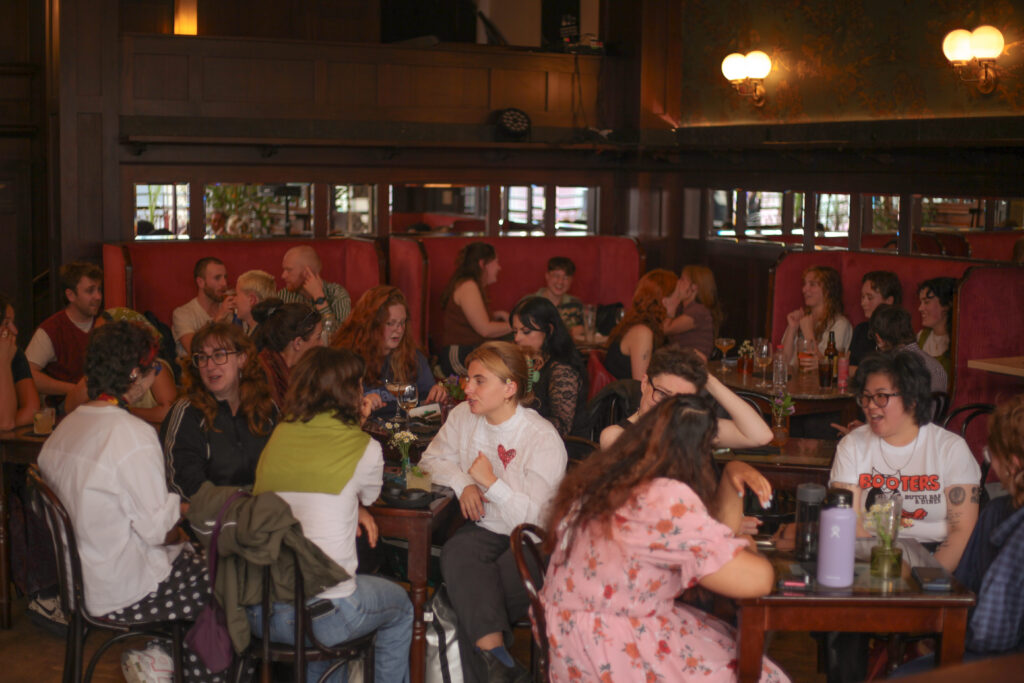
In 2024, Irish speaker, writer and musician Róisín Nic Ghearailt returned to her hometown of Dublin after seven years abroad and felt that something was missing. In the wake of her return, she was met with the overwhelming chorus of people vocalising their disillusionment with living in Dublin.
From 2017 up to her return, the median price of a property across the country had risen by a staggering 68%, according to the Central Statistics Office. The average number of pubs that shut down climbed from 78 a year to 128, with pubs not only being a spot for a pint but a community and cultural hub for many. People were struggling to buy a house, keep their local and, in turn, build the communities that really matter. “The thing I found most difficult to adjust to was this narrative saying Dublin is dead and we’re all at its funeral,” Nic Ghearailt said.
“The thing I found most difficult to adjust to was this narrative saying Dublin is dead and we’re all at its funeral”
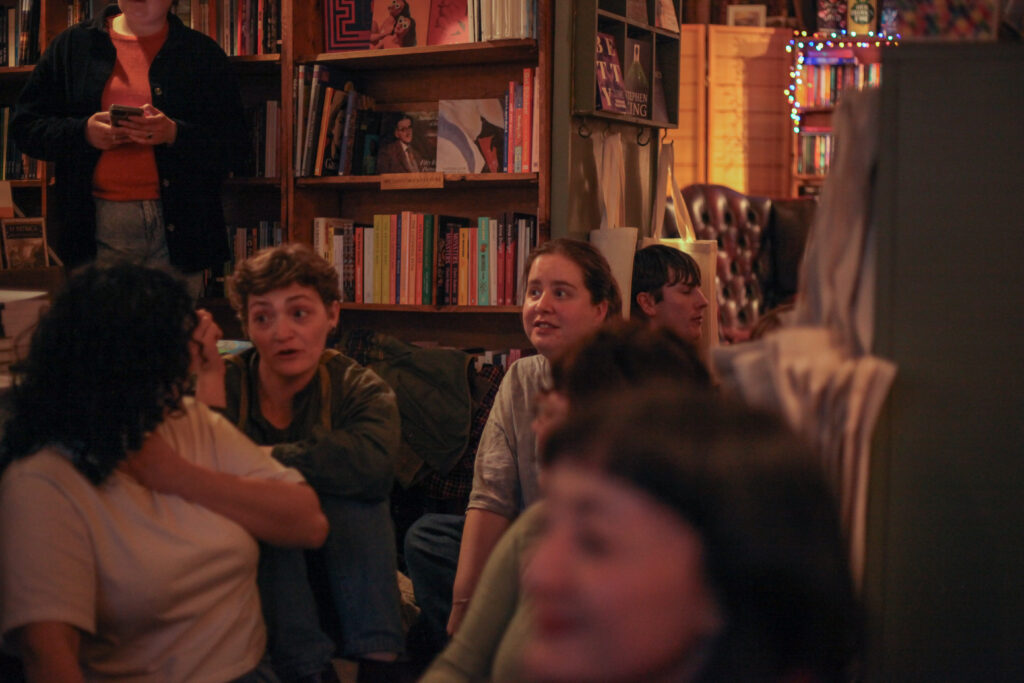
So Róisín didn’t accept that narrative, and instead started building something that combated this story: Salon Rógaire, a bisexual and bilingual literary salon, with a focus on Irish.
One of her inspirations for wanting to create something new in Dublin was the film Girls & Boys by Donncha Gilmore, which tells a trans love story set in Dublin. “Every city has many different faces and I think we have been repeatedly shown the same face of Dublin but of course it has other faces too’,” she tells District.
This motivated her to show the other faces she knew existed in Dublin, the ones of growing queer and literary scenes she was a part of, as well as ones exploring Gaeilge in a laid-back setting versus the academic one most would be acquainted with. So she invited others into her perspective of the city by creating Salon Rógaire.
“Every city has many different faces and I think we have been repeatedly shown the same face of Dublin but of course it has other faces too”
The identity of Salon Rógaire is intrinsically linked with Nic Ghearailt’s own experience as a Gaeilgeoir and bisexual person, which she wanted to see reflected earnestly when shaping the community. “I wanted the lineups to be a bit of everything because that’s often the accusation that’s leveled at bisexual people”, she says. “I knew by doing this I wasn’t fitting neatly into anything, and so I was going to have to rely on bisexuals and bilinguals unite.”
What this ambition has resulted is a consistently diverse lineup, from young LGBTQ+ Gaeilgeoirs and allies sharing their writing for the first time to their oldest speaker at 75. The format is just as intentional too, with the literary salon originating as a way to make cultural conversation accessible outside of the royal court. This has resulted in a banding together of those once labelled rebels, like members of the queer community and Gaeilgeoirs, into a new reiteration of resistance.
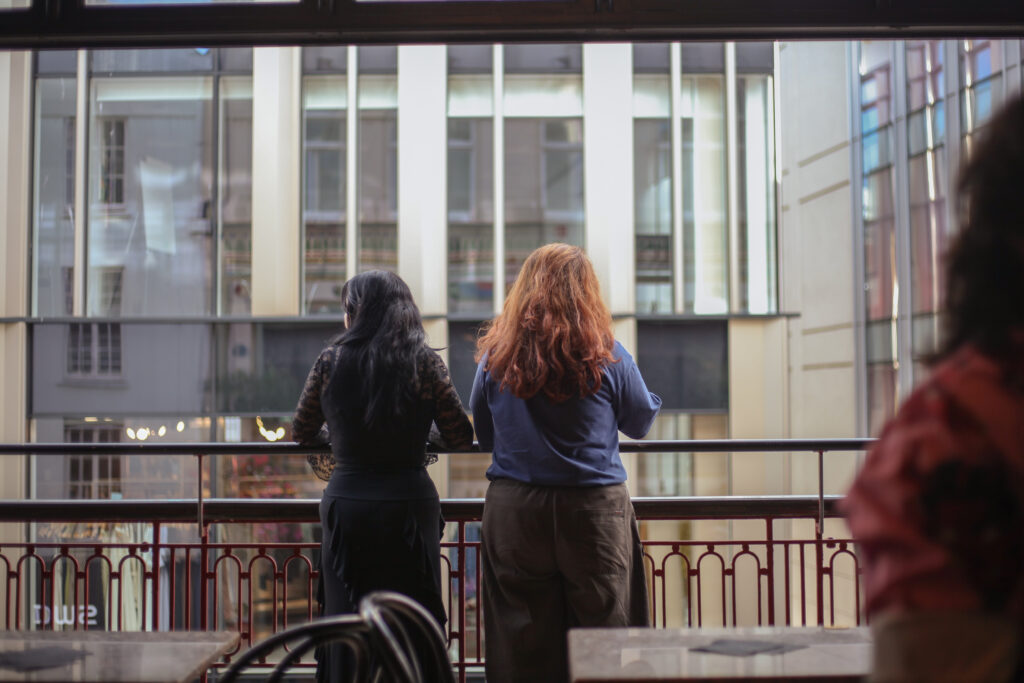
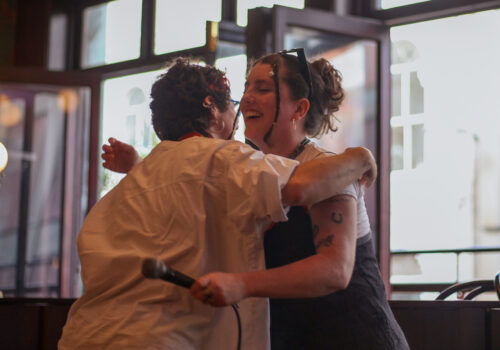
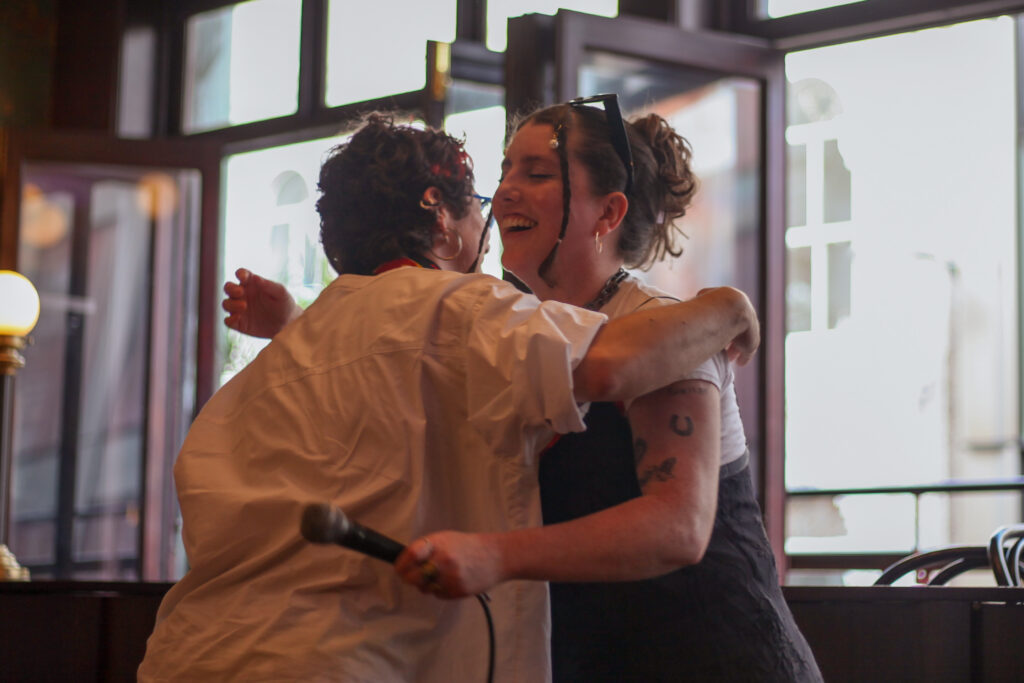
Over the two years of the community running, it has scaled from nights with crowds sat crosslegged clasping paper cups on the Winding Stair’s floors, to taking the stage at this year’s International Literature Festival Dublin.
The number of people who have found connection and friendship through the salon and beyond it continues to grow with it too. Clíona, a poet and regular attendee says, “I have met some of my dearest friends there, and I couldn’t ask for a more attentive and encouraging audience to share my work with. It is an incredibly creatively nourishing community space and I always know I’m in for a treat.”
“I have met some of my dearest friends there, and I couldn’t ask for a more attentive and encouraging audience to share my work with.”
Another member, Shane, spoke to us about the importance of spaces like this to him as a young queer person who recently returned home from Australia looking to build a community beyond his usual bubble of friends, which he has found to be a challenge. “I think there is something special that happens in queer community spaces that brings about a courage within people,” he tells District. “Often at these events it’s someone’s first attempt at presenting themselves to an audience and that vulnerability that comes with that grows into a sureness and courage in the face of adversity”.
At a time where community is needed more than ever due to the maelstrom of political, social and economic unrest that we are facing as a reaction to the rise of the far-right, inequality and rising cost of living. It’s groups like Salon Rógaire that encourage authenticity are proving that community first spaces are alive and thriving in Ireland, you just need to know where to look.